Almost every water storage project reaches the same fork in the road: put the tank on the roof, or put it in the ground. The two options solve different problems. A rooftop tank uses gravity to deliver pressure throughout the building; a below-ground tank relieves the structure and hides the storage entirely. Choosing badly leads to either a building that needs booster pumps it did not budget for, or a slab that needs strengthening after the fact.
This article compares the two approaches on the factors that decide real projects — structure, pressure, hygiene, maintenance and cost. Any experienced water tank manufacturer will walk a client through these before quoting, because the answer changes the tank specification completely.
Rooftop Water Tanks
Elevated storage is the traditional solution and still the simplest where it is feasible.
Advantages
- Gravitational pressure — water is delivered to the floors below without a pump, as long as the vertical drop provides the head the fixtures require.
- Simple pipework — a single down-feed riser serves the building.
- Easy to inspect — the tank is accessible without confined space procedures or excavation.
- Leaks are visible — a failure is noticed immediately rather than after water has travelled through the structure.
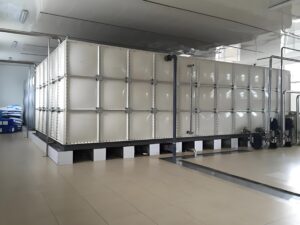
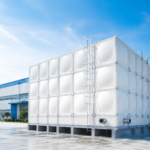
- Modular installation — sectional tanks are assembled on the roof, so no crane lift of a complete tank is required.
Limitations
- Structural load — a full tank imposes a substantial permanent load. A 20 m³ tank weighs 20 tonnes of water plus the tank itself, concentrated on a relatively small roof area.
- Pressure limits — a tank two or three floors above the highest fixture gives adequate pressure; the same tank on a low roof will not serve a tall building, and a booster set becomes necessary.
- Water quality risk — rooftop tanks in hot climates run warm, which encourages bacterial growth, and are more exposed to sunlight and airborne contamination without insulation and sealing.
- Freezing — in cold climates, exposed rooftop storage needs insulation or trace heating.
- Visual and planning constraints — some authorities restrict rooftop plant, and tall tanks may need screening.
Underground Water Tanks
Below-ground storage trades pressure for space and structure.
Advantages
- No structural burden — the tank does not load the building; the ground carries it.
- Cooler water — ground temperature is stable, which slows bacterial growth and keeps the water pleasant to use in hot climates.
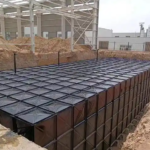
- Large capacity in limited space — a basement tank or an external buried tank can be far larger than a rooftop installation allows.
- Protected from weather — no UV exposure, no freezing risk and no wind loading.
- Concealed — no visual impact on the building or the streetscape.
Limitations
- Pumping is required — below-ground storage must be pumped to the building, adding pumps, controls and a power dependency.
- Flotation risk — where groundwater rises, the tank needs anti-flotation design (see our separate guide on this).
- Confined space access — inspection and cleaning are more difficult and require formal procedures.
- Leaks are hidden — a failure can go undetected until it causes damage or a measurable loss.
- Excavation cost — in hard ground or in city centres, excavation and disposal can dominate the project cost.
Side-by-Side Comparison
| Factor | Rooftop tank | Underground tank |
|---|---|---|
| Structural load on building | Significant — must be designed for | None |
| Water pressure at fixtures | From gravity head — may be sufficient | Requires booster pumps |
| Water temperature | Can run warm in hot climates | Stable and cool |
| Maximum practical capacity | Limited by roof area and structure | Limited mainly by site area |
| Inspection and cleaning | Straightforward | Confined space procedures |
| Leak visibility | Immediate | Often delayed |
| Protection from weather | Requires insulation and UV-stable materials | Inherent |
| Anti-flotation design | Not required | Usually required |
| Energy use | Lower — gravity does the work | Higher — pumping is continuous |
| Visual impact | Visible, may need screening | None |
How to Choose
- Choose rooftop storage where the building is low to medium rise, the roof can take the load, the climate is temperate, and the required capacity is modest.
- Choose underground storage where large volumes are needed, the building is tall or the roof is unavailable, the climate is hot, or concealment is required.
- Choose both where the building is tall and demands both capacity and pressure: a large ground-level or buried tank for bulk storage, plus a smaller elevated tank or a pressurised system for distribution.
- Remember the fire reserve — a fire tank has its own requirements and may need to be at ground level for pump suction regardless of where the domestic storage sits.
In practice, medium-rise and high-rise buildings often end up with a hybrid: bulk storage in a basement plant room or a buried tank, then a booster set feeding a small high-level tank or an accumulator to smooth pressure. Our direct water tanks are configured for exactly this arrangement, with the suction and level control details that a booster set installation requires.
Practical Points for Either Option
- Base design comes first. Both a roof slab and a buried base must be designed for the full water load, and the buried base also for uplift.
- Think about cleaning access. A tank that cannot be reached will not be maintained.
- Plan for turnover. Wherever the tank sits, keep stored volume in proportion to daily demand to avoid stagnation.
- Protect against contamination. Sealed covers, screened vents and approved materials are needed in both locations.
- Confirm with the structural engineer early. Installing a rooftop tank on a slab that was never designed for it is one of the most expensive mistakes in this field.
Frequently Asked Questions
Can a rooftop tank supply a 10-storey building?
Only if the tank is high enough above the highest fixture. Roughly 10 metres of head gives about 1 bar, and many fixtures need 1 to 2 bar to work properly, so a rooftop tank on a 10-storey building usually cannot serve all floors by gravity alone. A booster set is normally required.
Are underground tanks always more expensive?
Not necessarily. Excavation, disposal and anti-flotation works add cost, but they may be offset by avoiding structural strengthening and by the ability to install a much larger capacity for the same footprint. On constrained urban sites, below-ground storage is often the only option regardless of cost.
Which location gives better water quality?
Generally the cooler location. Stored water should be kept below about 20°C to limit bacterial growth, and below-ground or indoor storage reaches that far more easily than an exposed rooftop tank in a hot climate. In warm regions, an insulated or shaded tank is the practical compromise.
Can a rooftop tank be converted to a below-ground one later?
Effectively no — the pipework, pumping and base arrangements are entirely different. Since modular tanks can be extended, it is usually better to size the original installation correctly and expand it rather than relocate it. Discuss the growth allowance with your water tank supplier at the outset.
Summary
Rooftop storage gives you pressure for free but loads the structure and warms the water. Underground storage removes the structural burden and keeps water cool but needs pumps, excavation and anti-flotation design. Match the location to your building height, climate, capacity requirement and maintenance access — and check the structural implications before anything is ordered.
Deciding between rooftop and below-ground storage? Tell us your building height, capacity and site constraints and we will recommend the arrangement and tank configuration that fits.