Hotels, hospitals and data centres have almost nothing in common as buildings, but they share one characteristic that dominates water storage design: they cannot afford to run dry. A hotel loses rooms and reputation within hours; a hospital faces a clinical and regulatory failure; a data centre faces cooling interruption and equipment damage. In all three cases the storage requirement is driven by autonomy rather than by average consumption.
This article looks at how storage is sized in each of the three building types, and where the usual assumptions fail. As a water tank manufacturer we design storage for all three sectors, and the differences between them are more instructive than the similarities.
The Common Principle: Autonomy, Not Average
For domestic and office buildings, storage is often sized around a day of average demand. For critical facilities, that logic breaks down because the demand is not uniform and the consequences of interruption are severe. The sizing question becomes: how many hours of supply must the building survive with no mains at all?
- Hotel — guests must be able to shower, flush and be fed. Typical requirement: 12 to 24 hours of full-demand autonomy, with kitchens and laundry prioritised.
- Hospital — clinical functions, sterilisation, kitchens and sanitation must continue. Typical requirement: 24 hours minimum, often 48 hours for critical installations.
- Data centre — domestic demand is small, but cooling makeup water and humidity control may be substantial. The requirement is driven by the cooling design, not by occupants.
Hotels: Sizing Against the Worst Night
Hotel demand is spiky. It peaks in the morning and early evening, and it rises with occupancy, laundry operation, pool and spa use, and kitchen service. Sizing on average occupancy produces a tank that fails on a full house during a busy weekend.
A practical method:
- Calculate demand at design occupancy, not average occupancy.
- Size for the peak hour, which may be three to five times the average hourly draw.
- Add a separate allowance for laundry, pool top-up and irrigation, which can dominate on particular days.
- Apply the autonomy requirement in hours of full-demand supply.
- Check that the peak flow can be delivered from the tank without excessive pressure loss.
A 400-room hotel at 300 litres per occupied room per day, at 85% design occupancy, consumes roughly 102 m³ per day. Twenty-four hours of autonomy therefore means around 100 m³ of usable storage — plus fire storage separately, plus freeboard and dead volume, which pushes the nominal tank size higher again.
Hospitals: Sizing Against Continuity of Care
Hospital storage is governed by function rather than by comfort. Water is needed for patient care, sanitation, sterilisation, laboratories, kitchens and, in some cases, dialysis and process systems. Redundancy is built in at several levels:
- Storage autonomy — typically 24 to 48 hours, with the higher figure for critical care and surgical facilities.
- Dual supply paths — two tanks, or a compartmented tank with separate outlets, so maintenance on one part does not interrupt the other.
- Separate fire storage — always dedicated, never counted against domestic autonomy.
- Process water segregation — laboratory, dialysis and sterilisation requirements may need separate storage or dedicated treatment.
- Emergency contingency — some regulations require a stored reserve specifically for emergency use, such as water for sanitation during a supply failure.
The practical consequence is that hospitals rarely have one tank. Two compartments or two tanks of equal size are common, which also keeps the stored water fresher because each compartment turns over regularly.
Data Centres: Sizing Against the Cooling Load
In a data centre, the dominant water requirement is normally associated with cooling — evaporative systems, adiabatic cooling or makeup water for closed circuits. That makes storage sizing a mechanical engineering calculation rather than a plumbing one.
- Cooling makeup — determined by the cooling technology, the design wet-bulb temperature and the heat load.
- Evaporation and drift losses — significant for evaporative systems and highly climate dependent.
- Blowdown — determined by the number of concentration cycles the water treatment allows.
- Quality — cooling systems often need treated water, so storage may be paired with filtration or softening, and the tank material must suit the treated water chemistry.
- Reserve for maintenance — the ability to take one tank out of service while the facility continues at full load.
Domestic and fire storage still exist, but they are usually a small fraction of the cooling requirement. It is common for a data centre to hold several hours of cooling makeup water plus a separate potable reserve.
Configuring the Tank, Not Just Sizing It
Volume is only the first decision. For critical facilities, four configuration choices matter as much:
- Segregation — compartmented or multiple tanks for redundancy and to keep water turning over.
- Material — long life and low maintenance, with potable certification where drinking water is involved.
- Access — internal access for cleaning without draining the whole installation.
- Monitoring — level transmitters, high and low alarms and BMS integration, because an unnoticed shortfall is the failure mode that matters.
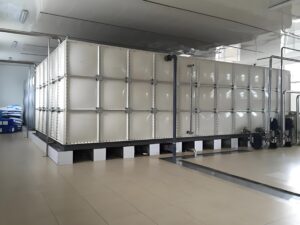
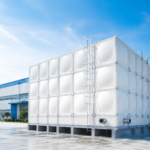
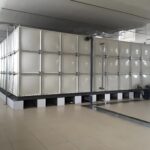
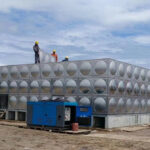
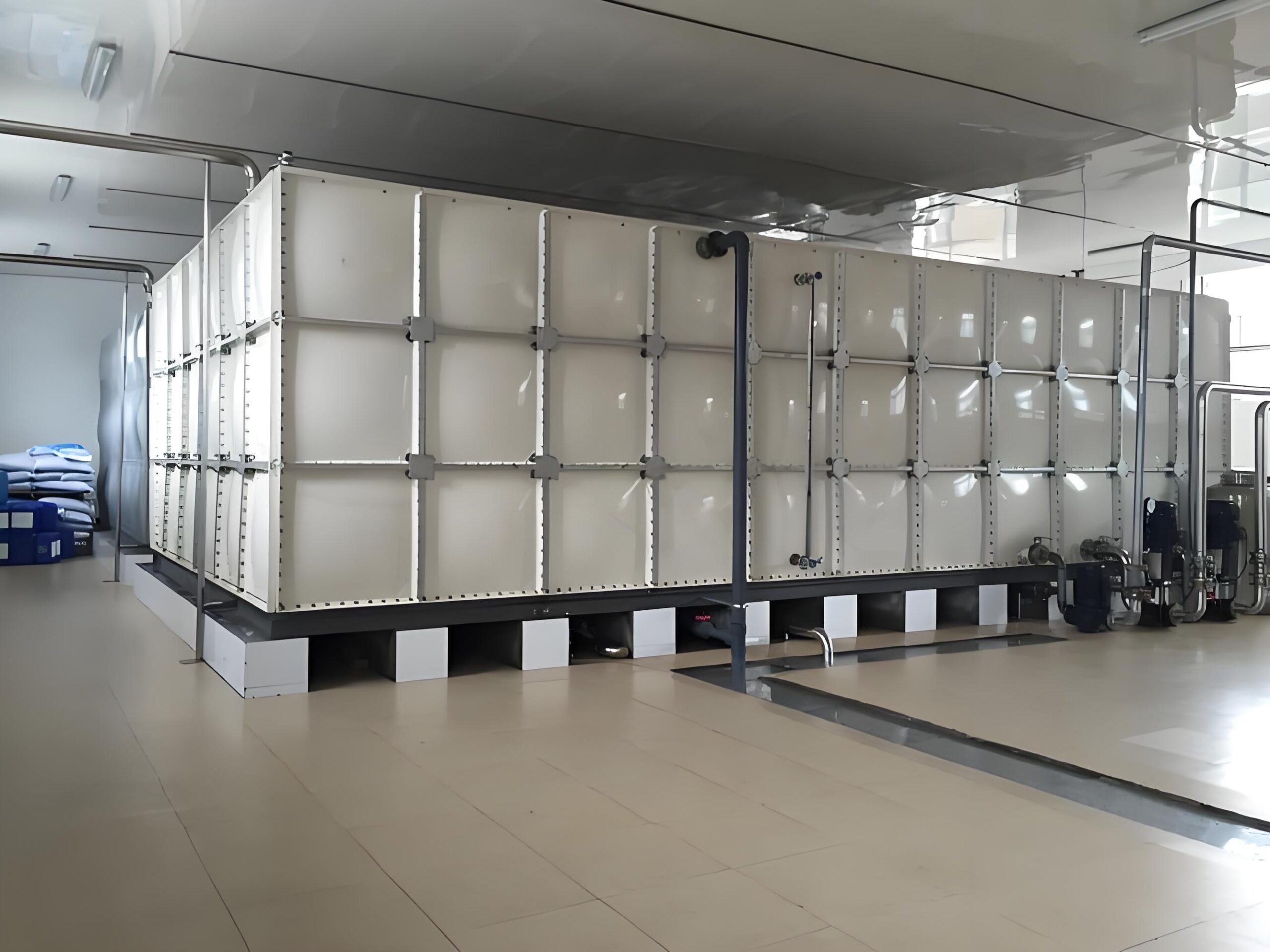
Our large water storage tanks are frequently supplied as multi-compartment installations for exactly these reasons, with the internal division designed in at the panel layout stage rather than added later.
Where Sizing Usually Goes Wrong
- Average occupancy instead of design occupancy. The tank is sized for a typical Tuesday and fails on the busiest day of the year.
- Ignoring process and cooling demand. Laundry, kitchens, pools and cooling can exceed domestic demand entirely.
- Counting gross volume as usable. Dead volume and freeboard typically remove 5 to 15%.
- Forgetting that maintenance needs redundancy. A single tank cannot be cleaned without an outage.
- Not allowing for growth. Modular tanks can be extended — but only if the slab and the plant room were sized for it.
Frequently Asked Questions
How many hours of storage should a hotel have?
Twelve to twenty-four hours of full-demand supply is a common range. The higher end suits hotels in areas with unreliable mains supply or with large laundry and spa loads.
Should a hospital have two tanks or one compartmented tank?
Either works. Two separate tanks give clearer physical separation; a compartmented tank saves space and is easier to install in an existing plant room. The key requirement is that maintenance on one part must not interrupt supply.
Does a data centre need potable water storage?
Yes, for staff welfare, sanitation and any humidification systems — but the volume is small compared with cooling water. The larger design question is the quality and treatment of the cooling makeup water and how it interacts with the tank material.
How do I allow for future expansion?
Size the plant room, structural slab and pipework for the future capacity even if the initial tank is smaller. A modular tank can then be extended later. Discuss the growth allowance with your tank supplier at design stage — retrofitting it afterwards is far more expensive.
Summary
Size critical-facility storage against autonomy in hours at design demand, not against average daily consumption. Add process and cooling loads, separate the fire reserve, plan for redundancy so maintenance is possible, and leave room to grow. Those five principles apply equally to a hotel, a hospital and a data centre.
Planning storage for a critical facility? Send us your design demand and autonomy requirement and we will propose a capacity and compartment arrangement to suit.