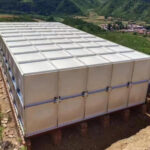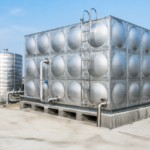
Choosing a water storage tank is never really a decision about one tank. The material you pick determines how long the tank will last, how much maintenance it will demand over the years, whether it is approved for drinking water, how easily it can be installed on your site, and — measured over twenty or thirty years — how much it actually costs.
For commercial buildings, industrial plants, hospitals, hotels, fire protection systems and municipal projects, four materials dominate the market: GRP / SMC sectional panel tanks, stainless steel tanks, galvanized steel tanks and concrete tanks. This guide compares them on the factors that decide most real projects: lifespan, cost, corrosion behaviour, water quality, maintenance and installation.
The Short Answer
There is no single best material — the right choice depends on your water source, environment, budget and expected service life. As a rule of thumb: GRP (also called FRP or SMC) panel tanks offer the best balance of corrosion resistance, low weight and cost for most commercial and industrial water storage; stainless steel delivers the longest service life and the highest hygiene level when the budget allows; galvanized steel is a cost-effective choice for very large capacities that are not exposed to aggressive water; and concrete suits very large in-ground reservoirs where on-site casting is practical.
What Is a Sectional Water Tank?
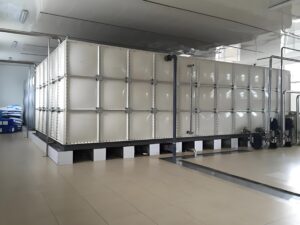
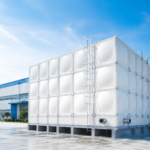
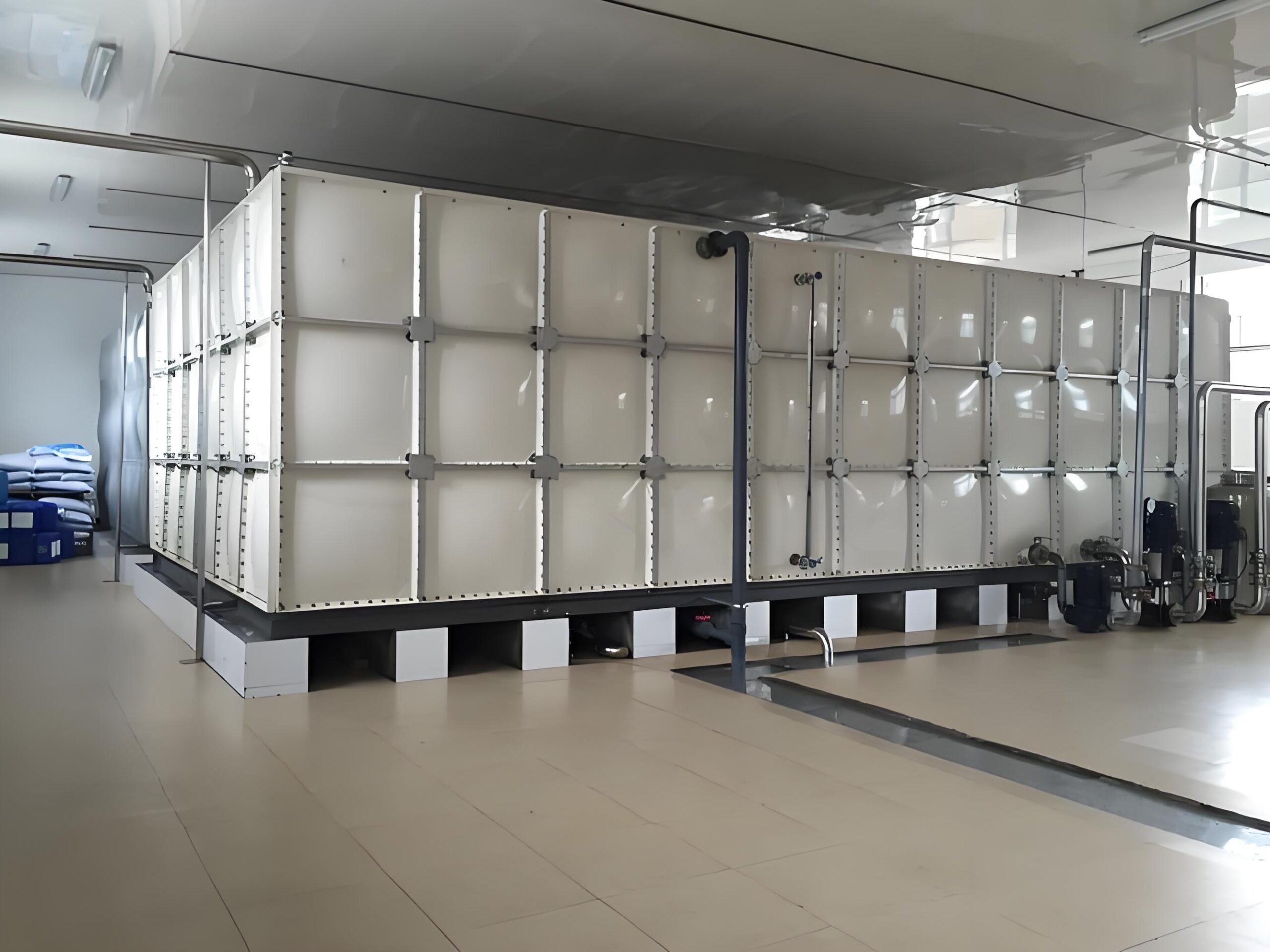
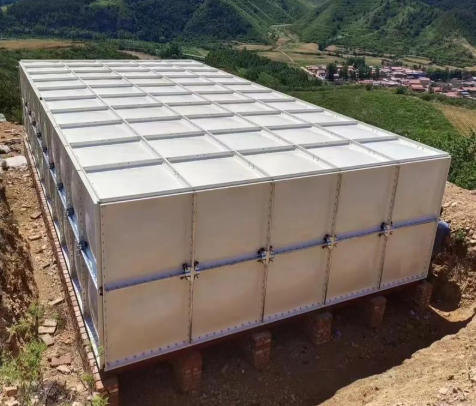
A sectional (panel) water tank is assembled on site from pre-fabricated panels that are bolted together and sealed with food-grade jointing compound. Because the panels are carried in through a standard doorway and assembled inside the plant room, sectional tanks can be installed in basements, roof plant rooms and other spaces where a one-piece tank could never be delivered or lifted into position. The modular design also means the tank can be enlarged or reconfigured later, and capacity is limited only by the available floor space and structural loading.
GRP/SMC, stainless steel and galvanized steel tanks are all normally supplied in sectional form. Concrete tanks are typically cast in place and are therefore closer to a permanent structure than to a modular product.
Head-to-Head Comparison
| Factor | GRP / SMC Panel | Stainless Steel | Galvanized Steel | Concrete |
|---|---|---|---|---|
| Typical design life | 20–30 years | 25–50+ years | 20–40 years | 30–50 years (with lining) |
| Initial cost | Low to moderate | Highest (often 2–3× GRP) | Low to moderate | High for small tanks, competitive at very large capacity |
| Corrosion resistance | Excellent — no rust, unaffected by aggressive water | Excellent with grade 304/316; risk of pitting in high-chloride water | Good while the zinc coating is intact; vulnerable once damaged | Poor without an internal lining; concrete is porous |
| Weight | Light — easiest to handle and install | Heavy | Moderate | Very heavy — requires structural foundation |
| Potable water suitability | Yes, with food-grade resin and WRAS / NSF approved materials | Yes — non-porous, easiest to sanitise | Requires approved internal coating | Requires certified internal lining |
| UV / weather resistance | Good when UV-stabilised; external gel coat should be inspected | Excellent | Excellent | Excellent structure; surface can craze |
| Maintenance | Low — periodic inspection and cleaning | Low — cleaning and inspection | Moderate — coating repairs | High — lining repair, crack and leakage repair |
| Installation time | Days — bolted assembly | Days to weeks | Days to weeks | Weeks to months — casting and curing |
| Typical best use | Commercial and industrial water storage, fire reserve, coastal and aggressive environments | High-spec potable water, food, pharmaceutical, marine | Large-capacity industrial and fire protection storage | Very large in-ground reservoirs and balancing tanks |
Material by Material
GRP / SMC Panel Tanks
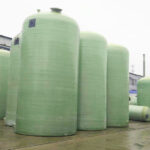
GRP (glass reinforced plastic) — also written FRP (fibre reinforced plastic) — is a composite of glass fibre and resin. SMC (sheet moulding compound) is a moulded form of the same family, produced by compression-moulding the compound into panels with a smooth, food-grade inner surface. Panel thickness is normally selected according to the water head, and the panels are bolted to a hot-dip galvanized steel frame with internal tie rods and bracing.
The composite does not rust, and it is not attacked by the mildly acidic or mineral-rich water that shortens the life of metal tanks. That single property explains why GRP panel tanks are the default choice in coastal regions, in industrial plants with aggressive water, and in locations where the tank may sit outdoors. Their low weight also reduces the structural load on an existing building and makes them far easier to manoeuvre into a plant room.
Stainless Steel Tanks
Stainless steel sectional tanks are built from pressed panels in grade 304 or grade 316. Grade 304 is the standard grade for cold and warm potable water in low-chloride environments. Grade 316 adds molybdenum, which improves resistance to chloride pitting — essential for coastal sites, food processing and water with a chloride content above roughly 200 mg/L, at a cost premium of around 10–15%.
Stainless steel offers the longest service life and the smoothest, most hygienic internal surface of the four materials, and it needs no lining or coating. The trade-offs are cost and weight: stainless steel is the most expensive option and the heaviest to install, and assembly must be handled carefully so that carbon steel tools do not contaminate the surface and seed corrosion.
Galvanized Steel Tanks
Hot-dip galvanized steel tanks use steel panels coated with zinc to ISO 1461. They are widely used for fire protection reserves and large industrial storage because they are structurally strong, tolerant of high water pressures at depth, and economical at large capacities. The zinc coating is effectively immune to UV degradation, so outdoor installations are not a problem.
The limitation is the coating itself. Once the zinc layer is scratched or consumed, the underlying steel is exposed and corrosion begins; coating repairs therefore form part of the maintenance routine. For potable water, an approved internal coating or lining is required.
Concrete Tanks
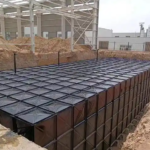
Concrete tanks are cast in place and, at very large capacities and in-ground locations, they can be competitive. Their weaknesses are practical rather than structural. Concrete is porous: without a certified internal lining it will not hold potable water to modern standards, and even lined tanks are vulnerable to hairline cracking, seepage and lining failure as the structure moves over time. Construction takes weeks to months, requires a substantial foundation, and the tank becomes a permanent, non-relocatable part of the building.
Service Life and Whole-Life Cost
Purchase price is the least reliable way to compare water tanks. Take a 50 m³ installation as an example. A GRP panel tank may cost significantly less to supply and install than an equivalent stainless steel tank, but over a 25-year horizon the calculation shifts: the cheaper tank may need coating or gel-coat attention, whereas a correctly specified stainless steel tank is often still well within its service life at the same point.
Concrete shows the same pattern in reverse. The structure itself can last decades, but lining repair, crack sealing and leak remediation are recurring costs that are frequently underestimated at design stage — and any period during which the tank is out of service has a real operational cost of its own.
The practical conclusion is to ask for a whole-life cost comparison rather than a purchase price, and to base it on the water chemistry on your site, the required design life and the access constraints of the installation. A tank that is cheap to buy but needs to be drained, repaired and re-lined twice in its life is rarely the cheaper tank.
Hygiene and Compliance for Potable Water
For drinking water storage, the material must be certified for potable contact and the tank must be designed so that it can be cleaned and disinfected. GRP panels are suitable for potable water when they are manufactured with food-grade resins and gel coats and certified accordingly, such as to WRAS in the UK or NSF/ANSI 61 in North America. Stainless steel is inherently non-porous and is the easiest surface to sanitise. Galvanized and concrete tanks require an approved internal coating or lining that must be maintained for the life of the tank.
Whichever material you choose, good practice for potable water is the same: a sealed, screened and vented tank, no dead legs, and a documented cleaning and inspection routine. Industry guidance such as BS EN 806-5 recommends internal inspection and cleaning at regular intervals — commonly every six months to a year depending on water quality — with full chlorination and testing before a new or repaired tank is returned to service.
Installation, Site Access and Logistics
Access is the factor that most often decides the material in practice. If the tank must be installed in an existing basement plant room, a sectional panel tank — GRP or stainless steel — is usually the only realistic option, because the panels are carried in by hand. If the tank is going underground outside the building, the choice widens to bespoke buried tanks and concrete structures, each with its own requirements for anti-flotation design, backfill and waterproofing.
Weight matters just as much. A GRP panel tank imposes a far lower dead load on the slab than a stainless steel or concrete tank of the same capacity, which can avoid structural strengthening work altogether.
How to Choose: A Practical Decision Guide
- Aggressive or coastal environment, or water that attacks metal: specify GRP / SMC panel tanks.
- High-spec potable water, food or pharmaceutical use, or the longest possible life: specify stainless steel, grade 316 where chlorides are present.
- Very large fire protection or industrial reserve with a tight budget: galvanized steel is the cost-effective structural option.
- Very large capacity, in-ground, where casting on site is practical: concrete, with a certified lining and a realistic maintenance budget.
- Restricted access, basement or roof plant room: a sectional panel tank in GRP or stainless steel.
- Unknown water chemistry: have the water tested before specifying, because chloride and mineral content change the material recommendation more than any other single factor.
Frequently Asked Questions
Can GRP panel tanks be used for drinking water?
Yes. GRP/SMC panel tanks are suitable for potable water storage provided the panels are manufactured with food-grade resin and gel coat and carry an appropriate certification such as WRAS or NSF/ANSI 61. This requirement should be stated explicitly in the specification, since not every GRP panel on the market is certified for potable contact.
Which is better for coastal sites — GRP or stainless steel?
It depends on both the external environment and the water itself. Stainless steel is excellent against atmospheric corrosion in coastal air, but grade 304 can suffer pitting if the stored water has a high chloride content, in which case grade 316 should be specified. GRP is not affected by chlorides at all, which makes it a very safe choice for coastal and marine environments.
How long does a sectional water tank last?
A correctly specified and properly maintained sectional tank commonly serves for 20–30 years in GRP and more than 25–50 years in stainless steel. Actual service life is governed far more by water chemistry, installation quality and maintenance discipline than by the material alone.
Do I need a concrete foundation for a panel tank?
Yes. Any sectional tank must sit on a level, flat and structurally adequate base — normally a reinforced concrete slab designed for the full weight of the tank when filled. Because GRP panel tanks are much lighter than stainless steel or concrete alternatives, the required slab is often simpler and cheaper to provide.
How often should a water tank be cleaned and inspected?
For potable water, internal inspection and cleaning are typically carried out every six to twelve months, with more frequent attention in dusty or high-sediment conditions. New or repaired tanks should be chlorinated and sampled before being put back into service. Keeping a written inspection record is standard practice and is often required for compliance.
Summary
GRP, stainless steel, galvanized steel and concrete tanks each solve a different problem. Matching the material to your water chemistry, environment, access constraints and required service life — and then comparing whole-life cost rather than purchase price — is what produces a tank that is still doing its job in twenty-five years’ time.
If you are specifying a tank for an upcoming project, send us your capacity, water source and site conditions and we will recommend the most suitable panel material and configuration for the application.