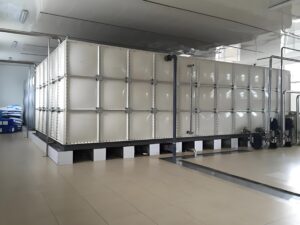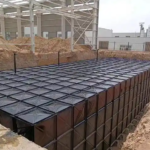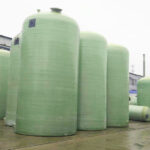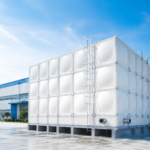
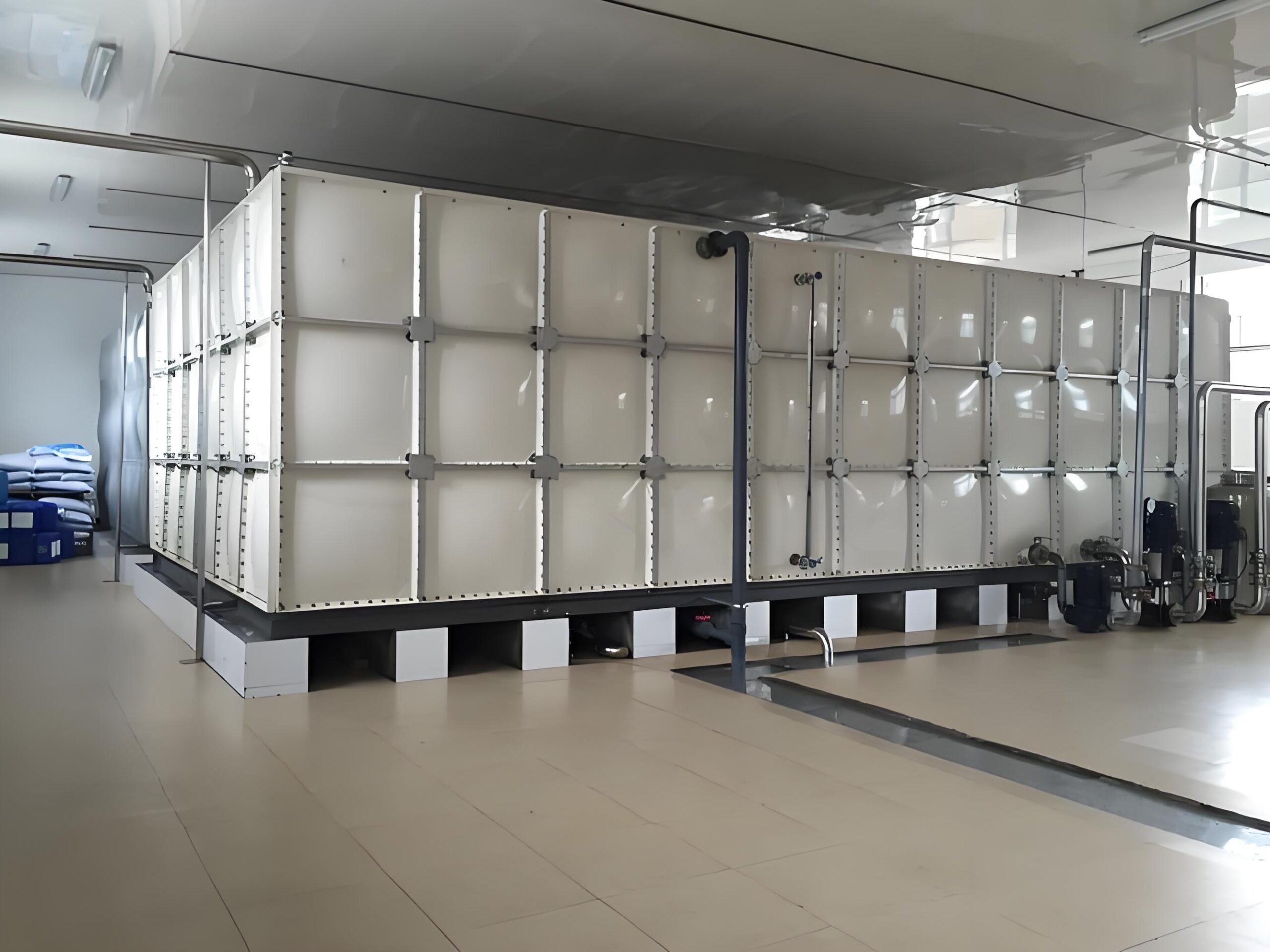
Two quotations for a “50 m³ GRP panel water tank” can differ by forty per cent, and both can be entirely honest. The difference is not usually margin — it is what is inside the specification. Panel thickness, resin content, the grade and coating of the steel frame, the sealing system and the accessory list all vary, and each one changes both the price and the life of the tank.
This article sets out the eight checks that separate a well-built panel tank from a cheap one, in the order they matter. They are the same questions our own engineers ask when reviewing a competitor’s specification, and any water tank manufacturer should be comfortable answering them in writing.
1. Panel Thickness
Panel thickness increases with water depth, because the pressure on the wall rises with the head of water above it. A tank built from a single panel thickness throughout is either over-thick at the top or under-thick at the bottom.
Ask for the thickness schedule by course. On a tall tank the difference between a properly graded specification and a “one thickness fits all” offer is real money, and the cheap version is normally the one that is under-thick where the load is highest.
2. Resin Type and Glass Content
An SMC or GRP panel is a composite of resin and glass fibre reinforcement, and the ratio between them decides how the panel behaves over twenty years. Higher glass content and a properly specified resin system give better mechanical strength, better resistance to water absorption and a slower loss of properties in service.
For potable water, the resin and gel coat must be certified for contact with drinking water — a point that must be stated explicitly, because not every panel on the market is. Ask for the resin system and, where applicable, the certification of the inner surface.
3. Frame and Fastener Corrosion Protection
The panels do not rust, but the structure that holds them does. Any uncoated carbon steel in a plant room — especially in a humid or coastal environment — becomes the weak point of an otherwise durable tank.
- Frame members should be hot-dip galvanized, and the coating thickness stated (commonly specified to ISO 1461).
- Fasteners should be stainless steel, not galvanized carbon steel.
- Cut ends of galvanized sections must be protected after fabrication; a cut edge is where corrosion starts.
4. Sealing System and Joint Design
Tank joints are where almost all leaks originate. The quality of the tank depends on whether the joint is designed to be sealed reliably on site:
- A pre-formed sealing surface or a gasket system that tolerates normal site tolerance, rather than a joint that relies on the installer applying sealant perfectly.
- Specified sealant or gasket material approved for potable water where relevant.
- Staggered joints between courses as a design requirement, not an installation preference.
5. Internal Bracing and Tie Rods
Tie rods and bracing carry the hydrostatic thrust. Under-specified bracing shows up as wall deflection when the tank is full — sometimes visible, sometimes only measurable — and it shortens the life of the joints. Ask for the tie rod arrangement and the design water depth it covers, particularly for tall tanks.
6. Internal Surface Finish
A smooth, moulded inner surface accumulates less biofilm and is easier to clean. Panels with visible print-through of the glass reinforcement, pinholes, or a rough or patchy gel coat will be harder to maintain and more prone to staining. This is one of the clearest physical differences between a good panel and a cheap one, and it can be assessed by eye on a sample.
7. Access, Roof and Potable Water Protection
The accessory list is where “equivalent” quotations quietly diverge. Confirm what is included:
- Sized manway with a close-fitting, lockable cover.
- Screened vent and insect mesh.
- Level indicator, and whether level controls and alarms are included.
- Anti-vortex outlet fittings.
- Insulation, if the climate demands it.
- Internal ladder and roof walkway where maintenance requires them.
A quotation that omits the vent screen and the level controls is not comparing like with like. Our GRP water storage tanks are quoted with an itemised accessory schedule precisely so the comparison is fair at tender stage.
8. Documentation, Certification and Support
Ask what arrives with the tank:
- Dimensioned general arrangement and assembly drawings.
- Weights and base loading figures for the structural engineer.
- Installation and commissioning instructions.
- Certification for potable water contact, where applicable.
- A stated warranty and what it actually covers.
- A route to spare panels, sealant and fittings in five years’ time.
Documentation costs the supplier effort and is the first thing cut from a cheap offer. Its absence becomes expensive when the base needs verifying or a panel needs replacing.
A Practical Tender Checklist
- Panel thickness stated by course, with the design water depth.
- Resin system named, with potable water certification where required.
- Frame galvanizing standard and coating thickness stated.
- Fasteners specified as stainless.
- Sealing system described, with the stagger requirement stated.
- Tie rod arrangement and depth rating stated.
- Accessories itemised individually rather than lumped into “fittings”.
- Drawings, weights, commissioning instructions and warranty terms provided.
Frequently Asked Questions
Why can two suppliers quote such different prices for the same size?
Almost always because the specifications differ — panel thickness schedule, glass content, frame protection or accessories. Comparing a 5 mm-graded tank against a 3 mm uniform one is not a price comparison at all.
Is a thicker panel always better?
Thicker than required at the bottom adds cost without benefit. What matters is that the thickness is graded correctly against the water head. An unnecessarily thick panel also adds weight and can complicate handling.
How can I check quality before the tank is delivered?
Request a sample panel or a factory visit, and ask to see the panel’s surface finish and the frame coating thickness. On an existing installation, look inside a tank of the same make after five years — the condition of the joints and the internal surface tells you more than any brochure.
Does a lower price mean a lower-quality tank?
Not necessarily — scale, manufacturing efficiency and regional costs all affect price legitimately. The reliable test is the specification. Ask every GRP water tank supplier to complete the same tender checklist, then compare the answers line by line.
Summary
Price differences between panel tanks are specification differences. Grade the panels against water depth, insist on certified materials, protect the steel frame, itemise the accessories and ask for the drawings. Do that and the cheapest offer usually stops being the cheapest option.
Comparing quotations for an upcoming project? Send us the specification and we will provide a full breakdown — panel schedule, frame, accessories and documentation — so you can compare like with like.