Fire water storage is the one part of a building services installation that must work on the day everything else has failed. That makes its requirements stricter than those for domestic storage: a guaranteed volume, a guaranteed refill, protected outlet arrangements, and regular documented inspection. This article sets out what actually goes into specifying a fire fighting water tank.
Fire storage requirements differ between countries and between sprinkler, hydrant and foam systems, so the governing document is always the local fire code and the system’s design standard. What follows are the principles that appear in nearly all of them — the questions a fire water tank manufacturer will ask before quoting.
How Fire Water Volume Is Determined
The required volume is not an arbitrary number — it follows from two inputs that come from the fire design:
- Design flow — the flow rate the sprinkler or hydrant system must deliver, in litres per minute or m³/h, determined by the hazard classification, the building’s occupancy and its height.
- Design duration — the period for which that flow must be sustained, commonly 30, 60, 90 or 120 minutes depending on the standard and the occupancy risk.
Volume = design flow × design duration. A 1,900 l/min sprinkler demand held for 90 minutes requires 171 m³ of dedicated storage. Add any hose reel or hydrant allowance determined by the same code.
The Fire Reserve Must Be Protected
A volume that exists on paper but can be drawn off by the domestic system is not fire storage. Three arrangements are used to protect it:
- Dedicated fire tank — separate tank, separate inlet, separate outlet. The simplest and most reliable option.
- Separate compartment — one structure divided internally so the fire volume is physically isolated.
- Protected outlet within a shared tank — the fire draw-off sits below the domestic draw-off, with level controls arranged so the domestic supply is interrupted before the fire reserve is touched.
The third arrangement depends entirely on controls working correctly for the life of the building. Where reliability is critical, best practice is a dedicated tank or a physical compartment.
Refill Requirements
A fire tank that has been used must return to service as quickly as the code requires — commonly within a defined number of hours. Two consequences follow:
- The inflow must be sized for the required refill rate, not for average daily demand.
- Automatic refill controls, level alarms and low-level warnings should be fitted and monitored, so an unreplenished tank is noticed before an incident rather than during one.
Where the mains cannot deliver the refill rate, a dedicated fire water supply, a suction tank arrangement for fire pumps or a stored reserve sized for a longer duration is required.
Suction Arrangements and Pump Protection
Fire pumps draw from the tank, and the tank must be arranged so the pumps work correctly:
- Anti-vortex outlet — prevents air being drawn into the pump at low water level, which causes cavitation and loss of pressure.
- Sufficient submergence — the outlet must remain submerged with an adequate depth of water above it at the lowest operating level.
- Dead volume allowance — the volume below the usable outlet level does not count towards the required fire volume.
- Freeboard — the top water level is set below the tank top to prevent overflow and to allow for wave action during rapid filling.
- Access for pump testing — the tank must be able to supply the pump’s test flow without being drained.
Material Selection for Fire Tanks
Fire water is typically static for long periods and then drawn at a high rate. That pattern favours materials that do not corrode while standing and can be fabricated in large capacities without excessive weight:
| Requirement | SMC / GRP panel | Galvanized steel | Stainless steel |
|---|---|---|---|
| Corrosion resistance with static water | Excellent | Good while coating intact | Excellent |
| Suitability at large capacity | Good — modular, low weight | Very good — strong at depth | Good but expensive |
| Installation in restricted access | Excellent — panels carried in | Moderate | Moderate |
| Indicative cost | Low to moderate | Low to moderate | Highest |
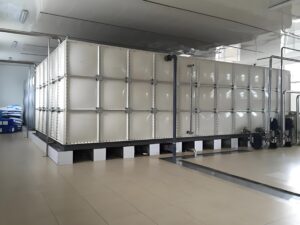
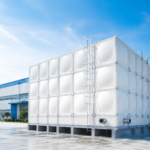
For most commercial buildings the choice comes down to GRP panels and galvanized steel, with stainless steel reserved for high-specification or aggressive-duty installations. Our fire protection water storage tanks are configured with dedicated fire outlets, anti-vortex fittings and level control as standard.
Inspection and Maintenance
Fire storage is inspected far more often than domestic storage, because its condition is only tested on the worst day. A typical programme includes:
- Weekly — visual check of water level and any level alarms.
- Monthly — confirm the tank is at its required level, check for leaks, confirm inlet valve operation.
- Annually — internal inspection, cleaning, checking of anti-vortex fittings and outlets, and verification that the pump test draw-down leaves the design reserve intact.
- After any activation — confirm the refill, then re-check the level and the pump suction arrangements.
All of it should be recorded. In most jurisdictions a written inspection log is part of the compliance evidence for the building.
Frequently Asked Questions
Can the fire tank also supply domestic water?
Only where the design guarantees the fire reserve is never consumed — normally through a dedicated compartment or a protected outlet with interlocks. Where fire and domestic supplies share a tank, the arrangements are inspected more closely and the risk of the reserve being depleted is borne by the building owner.
Does a fire tank need insulation?
In climates where stored water could freeze or overheat, yes. Insulation protects both the water and the structure: cyclic freezing damages panel joints, and high temperatures encourage bacterial growth in static water.
How is the required fire volume confirmed on site?
The standard method is to record the water level, run the pump at its rated flow for the design duration, and check that the design reserve remains untouched. The tank should be dimensioned to make this test straightforward, with clear level markings.
What is the most common specification error?
Counting the gross tank volume as the fire reserve. Dead volume, freeboard and anti-vortex clearance reduce usable capacity, so a tank quoted as 200 m³ may deliver noticeably less. Ask every water storage tank supplier to state the usable fire volume, not just the nominal capacity.
Summary
Fire water storage is defined by flow × duration, protected by dedicated or isolated arrangements, refilled at a specified rate and inspected on a documented schedule. Every one of those requirements should be visible in the tank specification before an order is placed.
Specifying fire water storage for a project? Send us the design flow and duration and we will size the tank, the outlet arrangements and the level controls around your fire design.