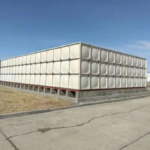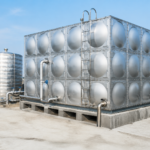
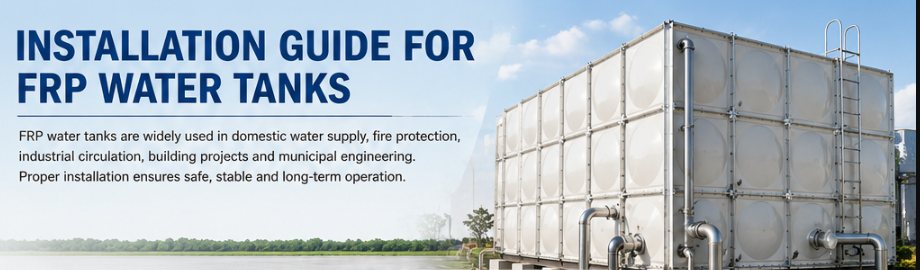
SMC GRP water tanks and FRP sectional water tanks are widely used in building fire protection, domestic water supply, industrial water storage, hotel and residential communities, municipal engineering and other scenarios due to their advantages of corrosion resistance, light weight, high strength, long service life and clean water quality. Standardized installation and construction are the core keys to ensure that fiberglass water tanks are leak-proof, deformation-resistant and operate stably for a long time. This article elaborates on the complete standard installation procedures, construction key points and acceptance specifications of assembled FRP water tanks, providing a complete reference standard for overseas engineering, foreign trade projects and on-site construction.
1. Pre-installation Preparation and Site Requirements
Site preparation and foundation treatment before construction directly determine the overall installation accuracy and sealing effect of the water tank, and are the main causes of water seepage and deformation of most water tanks in later use.
1. Foundation Ground Treatment: The FRP water tank needs a flat and solid concrete strip foundation or fully leveled ground. The overall level error of the foundation shall be controlled within ±0.5cm without protrusions, hollowing or cracks, which can fully bear the full water pressure weight of the tank.
2. Construction Space Reservation: A maintenance passage of no less than 800mm shall be reserved around the water tank, and an operating space of more than 500mm on the top, facilitating later maintenance, cleaning and pipeline upkeep, complying with international engineering construction standards.
3. Material Inspection and Verification: Check and count all complete accessories including SMC molded panels, sealing rubber strips, galvanized bolts, internal tension bars, angle iron brackets, manholes and flange fittings. Ensure all panels are free of cracks, peeling and damage, and sealing parts are intact and non-aging.
4. Tools and Safety Preparation: Prepare wrenches, levels, tape measures, electric welding machines and sealing tools. Take safety protection measures at the construction site to avoid panel collision and fragment scratches.

2. Channel Steel Base Welding and Leveling Construction
The base frame is the core load-bearing structure of the water tank. All assembled FRP water tanks require prior welding of the channel steel frame.
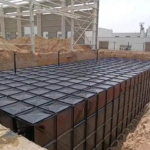
Cut channel steel of corresponding specifications according to the overall size of the water tank, and weld it into an integral frame based on the bottom panel layout. Ensure the frame is square with unified diagonal dimensions, full and uniform welding seams without virtual or missing welding. After welding, re-level with a level to ensure the entire frame is on the same horizontal plane, eliminating panel uneven stress and joint water leakage caused by inclined base.
Clean welding slag and sundries on the surface of the channel steel frame after installation to ensure close panel fitting, providing a flat support for subsequent bottom panel assembly.

3. Water Tank Bottom Panel Assembly and Sealing Treatment
The bottom panel is the first key waterproof procedure. The construction follows the principle of “positioning first, paving later, uniform sealing and gradual fastening”.
First, snap accurate installation positioning lines on the channel steel frame, and pave panels in order according to standard specifications (1000×1000mm, 1000×500mm). High-quality special sealing rubber strips are fully laid at all panel joints with complete fitting and no breaks, keeping joint gaps within the standard range.
Fasten bolts symmetrically in 3 to 4 times of uniform pressurization. Avoid excessive one-time tightening to prevent cracking and deformation of fiberglass panels, ensuring the bottom panel is flat and fully sealed.

4. Side Panel Assembly and Overall Straightening & Reinforcement
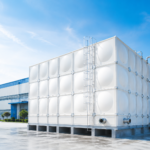
After the bottom panel construction is completed and inspected, assemble the tank side panels layer by layer. Stand panels in accordance with the numbering, align joints and fit sealing strips. After preliminary bolt fixing, calibrate the verticality and squareness of the tank with a level and ruler.
Large FRP sectional water tanks must be equipped with internal tension bars, transverse support rods and angle iron reinforcements. Configure corresponding reinforcement structures according to the height and volume of the tank to disperse water pressure impact, preventing bulging, deformation and cracking of the tank under full water load. It greatly improves the overall structural stability, suitable for large-scale industrial and fire water storage scenarios.
After the side panel assembly is completed, fully recheck all joints and bolt tightness, fasten loose parts to ensure the overall regularity and uniform stress of the tank.

5. Top Panel Installation, Manhole and Vent Configuration
Assemble the top panels after the side panels are fixed and shaped. Fully seal all top panel joints, focusing on waterproof sealing of corners and splicing seams to prevent top water seepage and dust entering the tank.
Install standard manholes, vent holes and maintenance openings at reserved positions to facilitate regular cleaning and maintenance inside the tank, balance the internal and external air pressure of the tank, and avoid abnormal negative pressure and water pressure affecting the tank structure. All top openings are constructed in standard specifications without forced cutting or violent processing.

6. Pipe Interface Installation and External System Connection
Standard interfaces of FRP water tanks include water inlet pipe, water outlet pipe, overflow pipe, sewage pipe and liquid level pipe. All pipes adopt flange connection technology, closely fitted with reserved tank interfaces with complete sealing gaskets to eliminate water leakage.
Random non-standard opening and violent welding cutting are prohibited during construction to avoid damaging the panel structure and anti-corrosion layer. The overflow pipe and sewage pipe are arranged smoothly at low positions to ensure controllable water level and complete water drainage of the tank, adapting to different scenarios such as fire water supply, domestic water storage and industrial water storage.
7. Full Water Pressure Test and Acceptance (Core Acceptance Standard)
A standard full water test is mandatory after all installations, which is the final criterion to judge the qualification ofGRP fire fighting water tanks and domestic water tanks.
1. Close all water outlet and sewage valves, and slowly fill the tank to the full water level;
2. Inspect all splicing joints, flange interfaces and pipe connections for no water seepage, dripping or damp marks;
3. Keep full water standing for 24 hours. The installation is qualified if the tank has no deformation, no leakage and no obvious water level drop;
4. Check that the tank structure, tension bars and brackets are under normal stress without looseness, abnormal noise or deformation.
8. Post-installation Maintenance and Precautions
1. Avoid heavy object impact on the tank after installation, and prohibit private punching, cutting and structural modification;
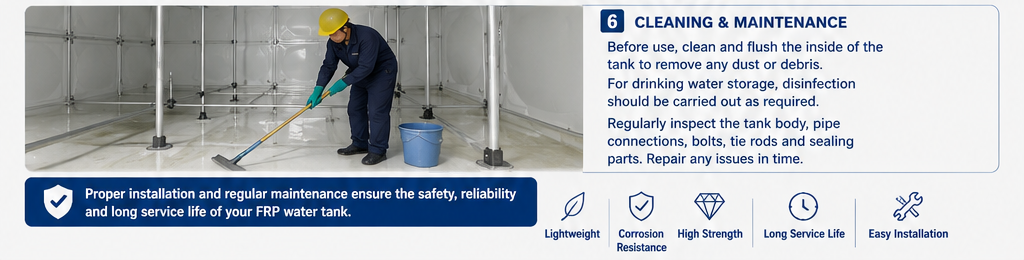
2. Regularly check bolt tightness and aging of sealing rubber strips, and replace aging sealing parts in a timely manner;
3. Clean and disinfect domestic potable water tanks regularly to ensure qualified clean water quality;
4. For long-term standby fire water tanks, regularly check the water level and pipeline patency to ensure availability in emergencies.
Conclusion
Standard SMC FRP water tank installation covers six core procedures: foundation leveling, base welding, panel assembly, sealing reinforcement, pipeline connection and full water pressure test. Strict construction in accordance with specifications can effectively ensure the tightness, stability and service life of fiberglass potable water tanks, fire water tanks and industrial water storage tanks, meeting the water storage demands of global construction, municipal and industrial overseas projects. Professional production and standardized installation services are the key to high-quality FRP water tank engineering implementation.