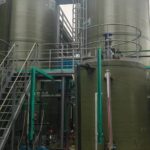
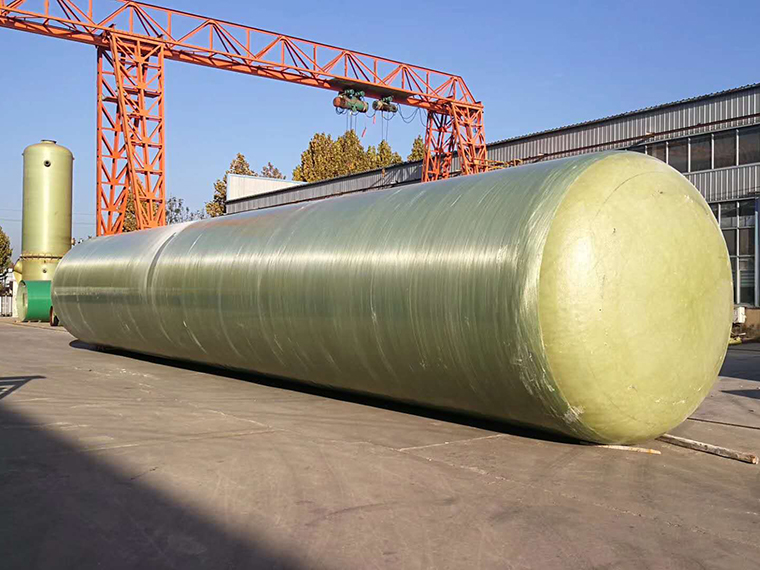
An FRP storage tank is the workhorse of industrial liquid storage: corrosion-resistant, light enough to move without heavy lifting gear, and mouldable into shapes and nozzle layouts that welded steel cannot match economically. This guide covers construction types, how to specify chemical compatibility, sizing and support, and the checks that prevent the majority of field failures.
Construction Types
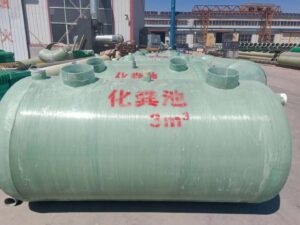
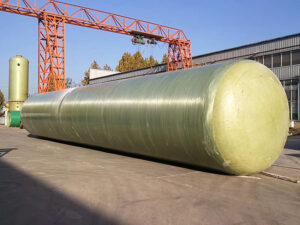
Filament-wound cylindrical tanks
Continuous glass roving is wound onto a rotating mandrel under controlled tension and resin content. Winding angle is programmed so the fibre carries hoop stress and longitudinal stress in the right proportions. This is the standard construction for vertical and horizontal FRP storage tanks in process duty, and for pressure vessels.
Contact-moulded (hand lay-up) tanks
Chopped strand mat and woven roving are laid into a mould by hand. Flexible and low tooling cost, so it suits one-off large vessels, rectangular tanks and complex geometries. Quality depends heavily on operator skill and on resin-to-glass ratio control.
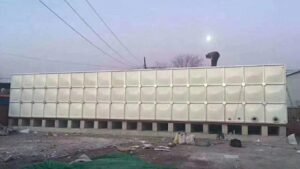
Moulded one-piece and panel tanks
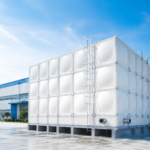
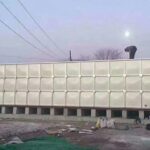
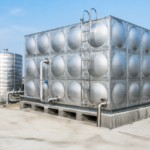
Compression-moulded SMC panels bolted into sectional tanks, or factory-moulded one-piece units. Predominant in water storage rather than aggressive chemical duty.
Chemical Compatibility: The Step People Skip
FRP is not universally chemical-proof. The resin determines chemical resistance; the glass provides strength. Before specifying, confirm compatibility for:
- The stored medium, including trace contaminants and cleaning agents
- Operating temperature — resistance drops sharply as temperature rises
- Concentration — a resin rated for 20% acid may fail at 60%
- Oxidising vs reducing environments
Ask the manufacturer for a compatibility statement referencing the actual medium, concentration and temperature. Generic “chemical resistant” claims are not a specification.
Resin selection guide
- Orthophthalic polyester — water, mild chemicals, cost-sensitive duty
- Isophthalic polyester — potable water, broader chemical range, higher temperature
- Vinyl ester — aggressive acids, alkalis, solvents and elevated temperatures
The internal corrosion liner is normally resin-rich (around 2.5–3 mm) with a surface veil, and the structural laminate does the load-carrying. Specifying liner thickness explicitly is worthwhile — it is the layer that determines service life.
Vertical vs Horizontal Configuration
- Vertical — smaller footprint, easier to drain fully, standard for bulk storage.
- Horizontal — low profile for transportable skids, plant rooms with height limits, and mobile units. Requires saddle supports designed to avoid shell deformation; saddle angle and the use of a wear pad matter.
Support, Foundation and Anchoring
FRP shells deform under point loads. Requirements differ by orientation:
- Vertical tanks need a flat, level, full-bearing base — concrete plinth or a purpose-made steel skirt.
- Horizontal tanks need saddles with a generous contact angle, typically 120–150°, with a resilient pad between shell and saddle.
- Wind and seismic anchoring must be engineered for the site; hold-down bolts should bear on the shell through a properly reinforced region, not through the liner.
Nozzles, Fittings and Accessories
Specify nozzle material and rating explicitly. Common requirements: inlet and outlet, drain, overflow, vent (sized for fill and drain rates, with an insect screen), level indication or a level transmitter, manway (minimum 600 mm for internal access), and lifting lugs. Nozzles are usually moulded in during manufacture — cutting them in afterwards voids most warranties.
Quality Assurance and Testing
A credible FRP storage tank manufacturer will provide:
- Barcol hardness readings confirming cure
- Laminate thickness records, including the corrosion liner
- Hydrostatic test to the agreed head, typically 24 hours with zero leakage
- Dimensional report
- Material certificates for resin and glass
- For potable duty, the relevant drinking-water certificate
Applications
- Potable and raw water storage
- Fire protection reserve
- Process water and demineralised water
- Acid, alkali and brine storage
- Effluent and wastewater holding
- Fuel and oil storage where a compatible resin is specified
Common Failure Modes — and How to Avoid Them
- Resin incompatibility — avoided by a written compatibility statement.
- Under-cured laminate — caught by Barcol testing before despatch.
- Point loading from poor supports — avoided by correct saddles / plinths.
- Vacuum collapse — caused by draining a tank with a blocked vent; specify and maintain vents.
- UV degradation — outdoor tanks need a UV-resistant outer layer or coating.
- Nozzle overload — pipework must be independently supported, never hung off the nozzle.
Planning a storage project? Send us the medium, concentration, temperature, volume and site conditions — we will recommend a resin system, liner build-up and support arrangement, and return a full specification with test documentation.