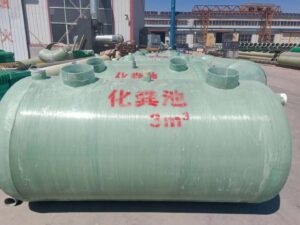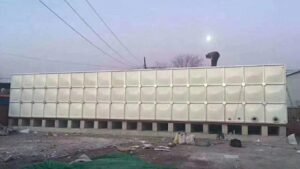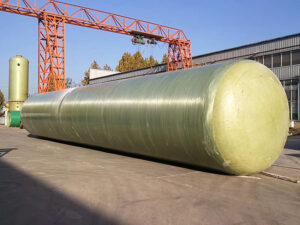
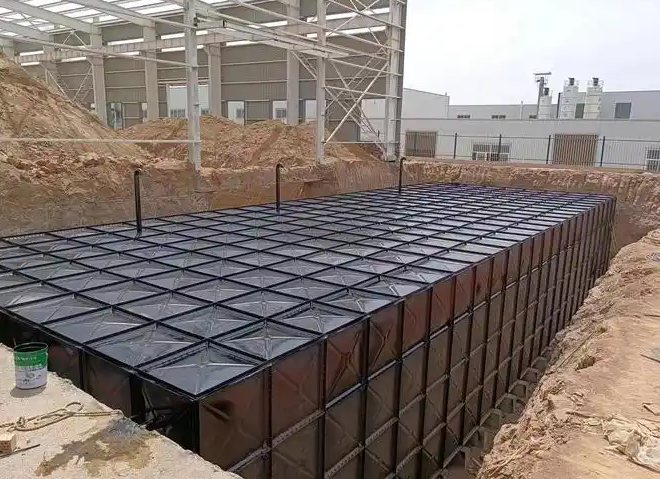
Underground fiberglass water storage tanks solve a problem that above-ground tanks cannot: storing large volumes without consuming usable floor area, while keeping the water cool, secure and protected from surface contamination. They are standard for rainwater harvesting, irrigation reserves, fire reserve on constrained sites, and fuel or chemical storage where a compatible resin is specified.
Why Choose Underground FRP?
- Space efficiency — the footprint becomes usable ground (parking, landscaping, roadway).
- Temperature stability — buried tanks hold a more stable temperature, reducing algal growth risk compared with exposed tanks in hot climates.
- Security and vandal resistance — the tank is inaccessible from outside.
- Corrosion immunity — FRP does not suffer the electrochemical corrosion that destroys buried steel, and needs no cathodic protection.
- Installation speed — delivered whole, set by crane, backfilled and commissioned, usually within days.
Design Loads: The Engineering That Matters
An underground tank is a buried structure. It must resist:
- Soil load (earth pressure) — depends on burial depth and soil density
- Hydrostatic pressure — groundwater pressure when the tank is empty
- Traffic load — if installed under a driveway or roadway
- Buoyancy (flotation) — an empty tank in saturated ground can float out of the excavation
Ring stiffness (typically to ASTM D2412 or equivalent) and wall construction must be specified against these loads. Reputable manufacturers supply a burial-depth and traffic-rating table for each model; if a supplier cannot produce one, treat that as a red flag.
Installation Procedure
1. Excavation
Excavate to the drawing, allowing working clearance all round for compaction. Over-excavation and loose backfill are the main causes of later settlement and shell distortion.
2. Bedding
Place a compacted sand or fine-gravel bed, typically 150–300 mm, level and free of stones. The shell must bear uniformly along its length — no point bearing on rock or debris.
3. Setting
Lower the tank using designated lifting points or slings under the shell with protection. Check level and alignment. For cylindrical tanks, ensure the shell is not forced out of round by uneven bedding.
4. Anti-flotation measures
In high water table conditions, either ballast the tank with water as backfill proceeds (fill and backfill in matched stages) or install concrete anchor slabs / ground anchors designed for the uplift.
5. Backfill
Use selected fine material free of sharp stones, placed in layers (typically 150–300 mm) and compacted to the specified density. Compact around the haunches carefully — this is where voids form.
6. Traffic-rated installation
Under roadways, a reinforced concrete slab is normally required above the tank to distribute wheel loads, with a cover depth per the manufacturer’s table.
7. Connections and access
Fit risers on access openings to finished ground level, vent to a safe location, and provide a lockable manway. All penetrations must be sealed by the manufacturer’s detail — field-cut openings usually void the warranty.
8. Testing and commissioning
Pressure or vacuum test the shell per the applicable standard, then water test. For potable duty, clean, disinfect, flush and sample before service.
Fuel Storage: Additional Requirements
Buyers searching for where to buy fiberglass underground fuel storage tanks should note that fuel duty imposes extra requirements beyond water storage:
- Double-wall construction with interstitial leak monitoring, or a single wall with secondary containment
- Resin compatible with the fuel (diesel, petrol, and especially ethanol-blended fuels)
- Overfill protection and spill containment at the fill point
- Compliance with the local environmental agency’s underground storage tank regulations — these are strict and vary by country
- Registration, periodic leak testing and decommissioning obligations
Never use a tank certified only for water in fuel service.
Inspection and Maintenance
Buried tanks should be entered only under confined-space procedure: gas test, ventilate, harness, and a standby attendant. Inspect annually for wall condition, sediment accumulation, and the integrity of seals and risers. Keep the vent and fill point secure, and maintain a log of inspections and any leak-test results — frequently a regulatory requirement for fuel tanks.
Choosing a Supplier
Ask for: burial depth and traffic load rating with the engineering basis, ring stiffness test data, shell wall construction detail, resin grade and compatibility statement, penetration sealing details, warranty terms for buried service, and installation drawings with backfill specification.
Planning a buried tank? Send us the required volume, burial depth, soil type and whether the surface will carry traffic — we will specify the wall construction, bedding and anti-flotation detail.