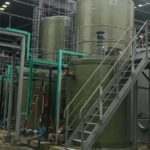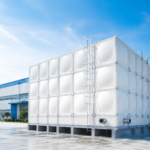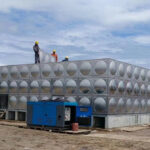

Standard tanks suit standard projects. When the plant room dictates the shape, the process dictates the nozzle layout, or the medium dictates the resin, you need a custom FRP tank. Custom composite fabrication is more flexible than most buyers expect — but it needs the right information up front to be economical. This guide covers when to go custom, what to specify, and how to select a factory.
When Custom Makes Sense
- Restricted or irregular footprint — a long, low or L-shaped tank to fit an awkward plant room
- Height restrictions — a shallow tank spread over a large plan area
- Combined duties — one shell with a divided potable compartment and a fire reserve compartment
- Process integration — specific nozzle positions, baffles, weirs, agitator mounts, or CIP spray devices
- Aggressive contents — a resin system selected against the actual chemical and temperature
- Unusual loads — seismic, wind, or a rooftop installation
- Transport constraints — sectional construction to pass through a door or down a shaft
Information to Provide at Enquiry Stage
The more of this you can supply, the faster and more accurate the quotation:
- Contents — water, effluent, or a named chemical with concentration
- Operating temperature and pressure (including vacuum conditions)
- Volume — nominal and usable
- Available space — maximum length, width and height, plus the access route
- Orientation — vertical or horizontal
- Nozzle schedule — quantity, size, purpose and preferred positions
- Access requirements — manway size and location
- Site conditions — indoor/outdoor, wind, seismic zone, ambient range
- Applicable standard and any certification required
- Quantity — one-off or repeat; tooling amortisation affects unit price
Design Options Available in FRP
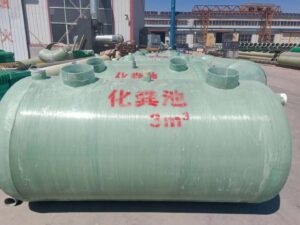
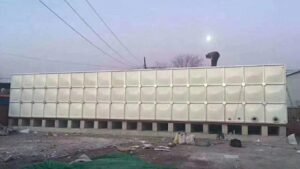
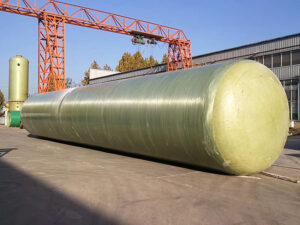
- Geometry — cylindrical vertical, cylindrical horizontal, rectangular, or a bespoke profile
- Ends — dished, flat or conical, with slope for full drainage
- Compartments — internal division walls for separate duties in one shell
- Baffles and weirs — for process separation or flow control
- Integrally moulded supports — saddles, legs, skids or lifting lugs
- Insulation and cladding — integrated during manufacture
- Finished surfaces — food-grade internal finish, UV-resistant external gelcoat, or a specified colour
- Instrumentation ports — level, temperature, pressure
Choosing a Custom FRP Tank Factory
The gap between a capable factory and a trading company is large. Assess on:
- In-house capability — filament winding, contact moulding, compression moulding; can they show the plant?
- Engineering support — is design done in-house, with calculations and drawings?
- Material traceability — resin and glass batch records
- Testing capability — hydrostatic, pressure, Barcol, thickness
- Certifications — potable, and any industry-specific approvals
- Relevant references — comparable custom work, ideally in your industry
- Export experience — packing, container loading, documentation, if shipping
- Lead time and MOQ — and whether tooling cost is charged separately
Cost Drivers in Custom Work
- Tooling — a new mould is a one-off cost amortised over quantity
- Engineering time — design, calculation and drawing
- Resin system — vinyl ester and certified potable resins cost more
- Complexity — number of nozzles, compartments and penetrations
- Testing and certification — beyond a standard hydrostatic test
- Quantity — unit cost falls sharply after the first article
Lead Time Expectations
For a one-off custom vessel, allow for engineering, tooling where required, manufacture, test and despatch. Repeat orders from an existing mould are much faster. Agree a programme with defined hold points — drawing approval, material approval, and test witness — before manufacture starts.
Have a non-standard requirement? Send us the duty, available dimensions and nozzle layout — we will return a design proposal with drawings, material specification, test plan and a delivered price.