How to Evaluate a Supplier
Manufacturing capability
- Does the supplier mould in-house, or assemble bought-in panels?
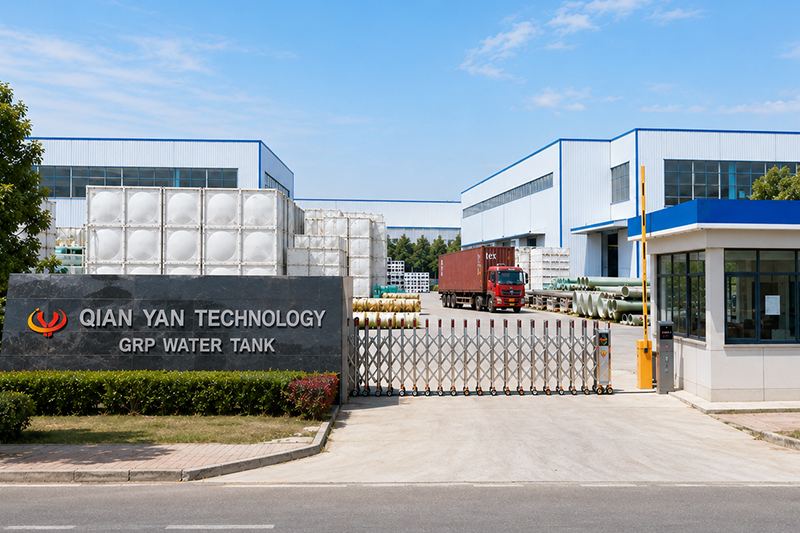
- What processes are available — compression moulding (SMC), filament winding, contact moulding, stainless fabrication?
- Can they provide a factory audit, production video, or third-party inspection report?
Quality evidence
- Batch traceability for resin and glass
- Barcol hardness and thickness records
- Hydrostatic type-test reports
- Dimensional inspection reports
- Potable certification naming the actual formulation — NSF/ANSI 61, WRAS, or the scheme your market requires
Export competence
- Experience shipping to your market — and familiarity with its certification requirements
- Export packing: panel protection, container loading plan, and moisture protection for sea freight
- Documentation: commercial invoice, packing list, certificate of origin, test certificates, and any conformity documentation required on import
- Incoterms clarity — EXW, FOB or CIF, and what each includes
Commercial terms
- Lead time and whether it includes engineering approval
- Payment terms and whether a deposit is tied to defined milestones
- Warranty, and how a claim is handled across borders
- Spares availability for the panel moulding over the tank’s life
Regional Considerations
Different markets impose different requirements, and a supplier experienced in your region saves real time:
- Middle East (Gulf) — municipal or civil defence approvals frequently required in addition to international standards; high ambient temperatures make insulation important.
- Southeast Asia — markets such as Malaysia, where SMC water tank specialists operate, often reference British or European standards alongside local authority rules.
- North America — NSF/ANSI 61 and AWWA standards dominate; FRP tanks supplied into Canada and the northern USA additionally need freeze protection.
- Africa — often the most price-sensitive, with variable local certification; robustness and spares availability matter most.
Logistics: What Buyers Underestimate
Panel tanks ship efficiently because panels pack flat — a large tank can fit in a fraction of the container space a monolithic tank would need. Points to confirm:
- Container loading plan and total shipment volume before you commit
- Panel and gasket protection against moisture and crushing
- Whether gaskets, fasteners and accessories are included in the same shipment — a missing gasket set delays the entire installation
- Consolidation of spares into the same container
- Clear labelling against the panel schedule, so site assembly is not a sorting exercise
Verification Before Shipment
Arrange a pre-shipment inspection covering panel count and condition, dimensional checks, documentation completeness, packing quality and container loading. Third-party inspection is inexpensive relative to the cost of discovering a shortfall after the container arrives.
Working With Us
We are a manufacturer supplying SMC, FRP, GRP and stainless steel water tanks for potable, fire and process duty, exporting to the Middle East, Southeast Asia, Africa and North America. We provide panel schedules and foundation drawings, material and hydrostatic test documentation, potable certification for the actual formulation, and export packing with a container loading plan.
Requesting a quotation? Send us the tank type, capacity, duty, destination port and the certification your market requires — we will return a specification, delivered price and lead time.