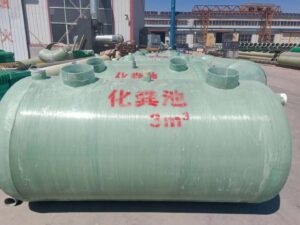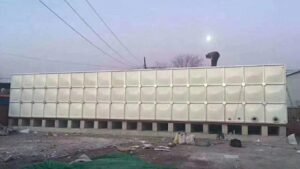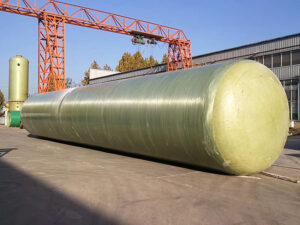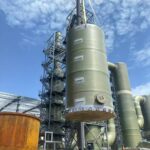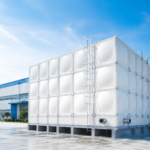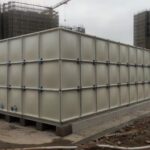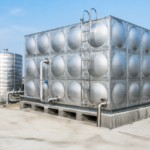
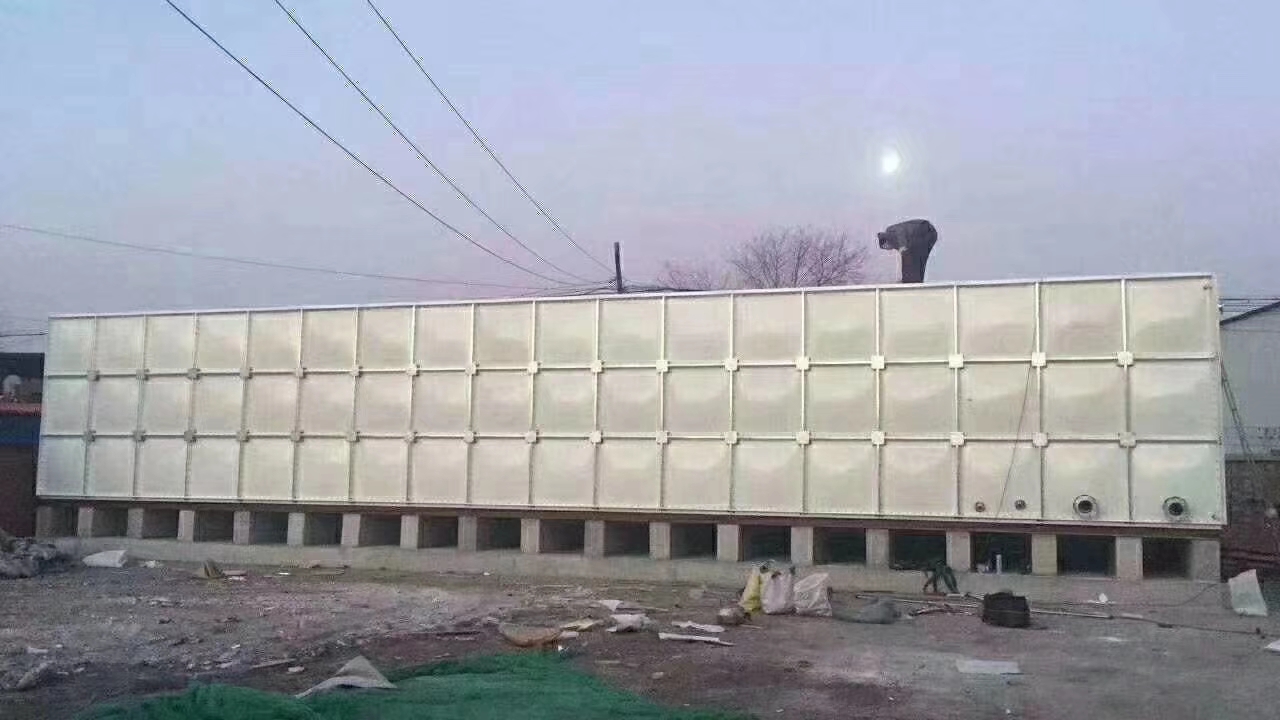
A GRP water tank (Glass Reinforced Plastic) is the European and Middle Eastern term for what much of Asia and North America calls an FRP or SMC tank: glass fibre reinforcement in a thermoset resin matrix, formed into panels or shells for water storage. If you are writing a specification under a British, European or Gulf standard, GRP is the term you will encounter most often.
GRP, FRP and SMC — Same Family, Different Names
All three refer to glass-reinforced thermoset composites. The practical distinction in the tank industry:
- GRP — the term used in UK, European and Gulf specifications; most often a GRP sectional water tank assembled from flat panels.
- FRP — the US and Asian umbrella term covering panel tanks, one-piece moulded tanks and filament-wound vessels.
- SMC — a specific manufacturing route (compression moulding of Sheet Moulding Compound) used to make the flat panels.
In other words, the panels in a GRP sectional tank are very often SMC panels. The acronyms describe the material family and the process, not competing products.
What a GRP Sectional Tank Consists Of
- Panels — typically 1 m × 1 m, 1 m × 0.5 m or 1 m × 2 m, ribbed for stiffness, with thickness graded by water depth.
- Gaskets — food-grade EPDM or PVC tape bedded into the flange channels.
- Fasteners — stainless steel or hot-dip galvanised bolts, washers and nuts.
- Internal stays and tie rods — transfer hydrostatic load from the walls to the joint structure.
- Base channel or skid — distributes load to the foundation.
- Accessories — manway, inlet, outlet, drain, overflow, vent, level gauge, ladder.
Standards That Apply
For potable applications, the commonly referenced frameworks are:
- BS EN 13280 — GRP tanks for water supply, covering materials, design and testing.
- WRAS approval — required where the tank connects to UK mains.
- NSF/ANSI 61 — the North American drinking-water benchmark, often requested even outside the USA.
- BS 6920 — British standard for the effect of non-metallic materials on water quality.
- Local authority approvals — many Gulf and ASEAN projects require a municipal or ministry certificate in addition to the above.
Insist that the certificate names the actual resin and panel formulation to be supplied. A company-level certificate is not evidence of product compliance.
Corrosion Resistance: The Core Advantage
Corrosion resistant GRP tanks are specified precisely because they eliminate the failure modes of coated steel:
- No internal lining to inspect, repair or replace
- No rust particles in potable water
- Immune to the electrochemical corrosion that affects buried or externally wetted steel
- Stable in humid, coastal and chemically aggressive plant environments
For external duty, the resin system should include UV stabilisers, or the tank should be clad or painted. UV attack is a surface phenomenon, but left unaddressed it erodes the outer resin layer over years.
Sizing and Price Drivers
When buyers compare GRP sectional water tank prices, the spread usually comes from factors that have nothing to do with the tank being cheap or expensive:
- Panel thickness and glass content — a thicker, higher-glass panel costs more and lasts longer
- Resin grade — isophthalic or vinyl ester costs more than orthophthalic
- Potable certification — certified resin systems carry a premium
- Tank height — taller tanks need thicker lower panels and more internal stays
- Insulation — PU or rockwool cores plus cladding
- Seismic and wind design — additional bracing
- Delivery scope — ex-works vs delivered vs installed, and whether commissioning and disinfection are included
Compare like for like: ask each bidder to quote against a written specification that fixes resin grade, panel thickness by course, certification and scope.
Choosing GRP Water Tank Suppliers
Assess a supplier on evidence rather than brochures:
- Does it manufacture in-house, or assemble bought-in panels?
- Can it produce batch traceability — resin, glass content, Barcol hardness, thickness?
- Can it show a hydrostatic type test for the model quoted?
- Does it hold potable certification for the exact formulation?
- Can it supply comparable references in your region?
- What are lead time, packing method and export documentation if shipping?
- Is there a written warranty, and what does it exclude?
Maintenance
GRP tanks need little but not zero maintenance. Annual internal inspection, re-torque of bolts after first fill and at 12 months, periodic gasket and fastener replacement, and cleaning plus disinfection at commissioning and after any contamination incident. Keep the vent screen and overflow screen clear — blocked vents cause both contamination and vacuum deformation.
Comparing GRP tank quotations? Send us the competing offers and we will benchmark them against resin grade, panel schedule and certification so you can see what you are actually buying.