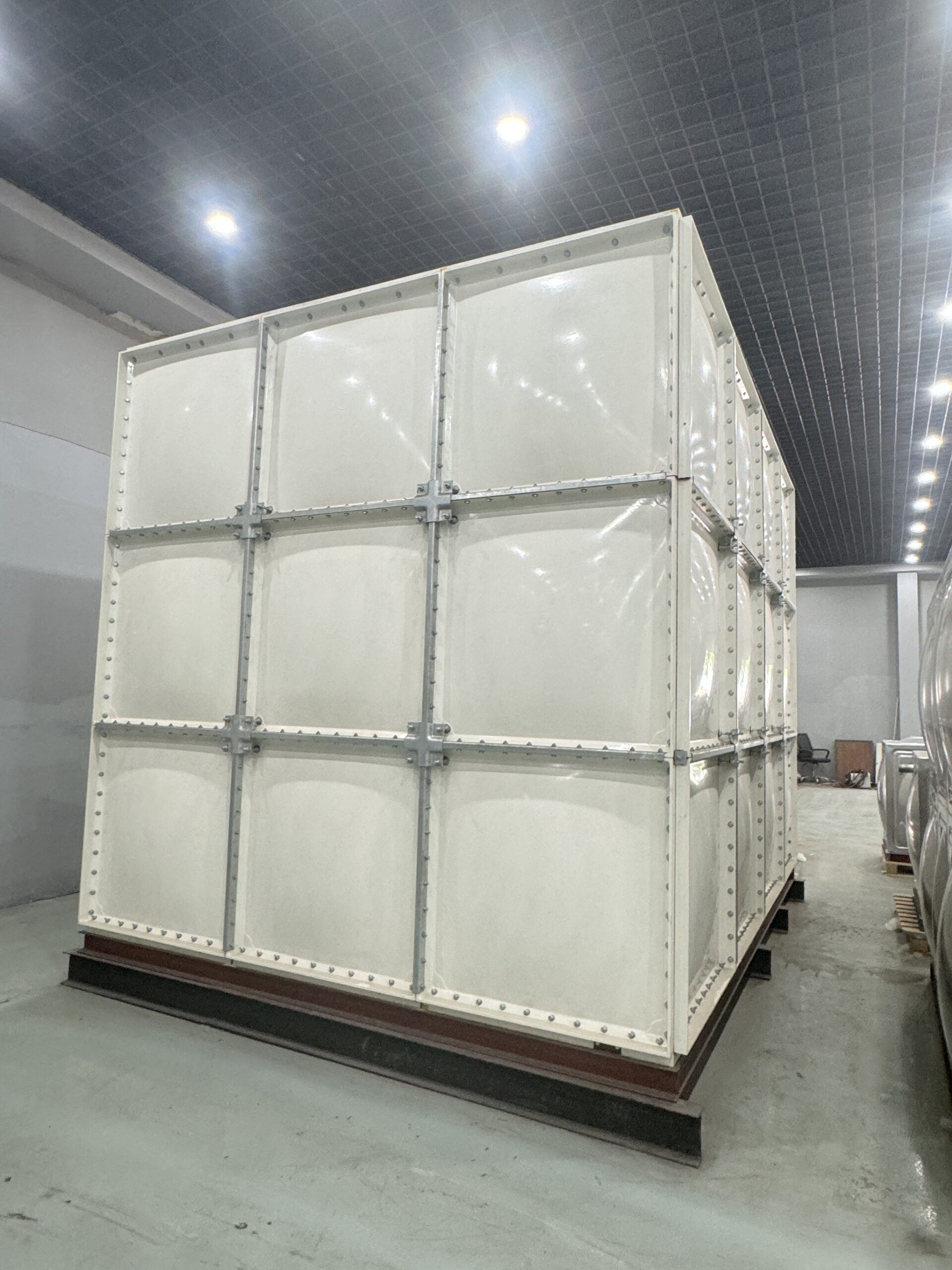
FRP and GRP tanks are low-maintenance, but “low” is not “zero”. A short annual inspection catches the small issues — a weeping gasket, a blocked vent, a trace of sediment — before they become a drained tank, an emergency repair and a water quality incident. This guide sets out a practical maintenance regime and explains how GRP tank repairs are carried out when they are needed.
Annual Inspection Checklist
External
- Panel alignment and any bulging, particularly on lower courses
- Bolt condition — corrosion on fasteners, and torque
- Gasket condition at joints, with any signs of weeping or staining
- Base and support — settlement, cracking, corrosion of steel skids
- Insulation and cladding integrity
- Vent and overflow screens — clear, intact, insect-proof
- Ladder, handrail and access platform condition
Internal
- Sediment depth on the floor
- Surface condition — blistering, cracking, exposed glass, or a rough / chalky feel indicating resin erosion
- Joint condition — gasket extrusion or movement
- Stays and tie rods — tension and corrosion
- Nozzles and penetrations — sealing integrity
- Level gauge and alarms functioning
- Roof underside — condensation, corrosion at fittings, any signs of light ingress
Record findings with photographs. Trend data makes it far easier to argue for a repair before a failure.
Routine Maintenance Tasks
- Re-torque bolts after first fill and at 12 months, then as inspection dictates
- Clean and disinfect annually for potable tanks, and after any contamination event
- Clear screens on vents and overflows — a blocked vent can cause vacuum deformation
- Exercise valves so they do not seize; a seized drain valve turns every future clean into a project
- Check alarms — low-level and high-level, including the fire reserve alarm where fitted
- Top up insulation and repair cladding damage promptly
Common Problems and Their Causes
- Joint weeping — gasket ageing, insufficient torque, or base settlement. Usually fixed by re-torquing; persistent cases need gasket replacement.
- Panel bulging — missing or slack internal stays, or overfilling beyond the design head.
- Surface chalking or fibre bloom — resin erosion from chemical attack or UV; needs assessment of whether the laminate is still sound.
- Cracking around nozzles — pipe load carried by the nozzle rather than independent pipe support.
- Discolouration or odour — biofilm, stagnation or contamination; requires cleaning, disinfection and sampling.
- Deformation after draining — blocked vent causing vacuum collapse; a serious event requiring structural assessment.
How GRP Tank Repairs Are Done
Minor surface repairs
Clean and abrade the area, apply a compatible resin with glass mat or veil, cure, and finish with a food-grade topcoat for potable contact. Surface repairs must not simply cover a structural problem.
Gasket and fastener replacement
The most common repair on sectional tanks. Drain, remove the affected bolts, clean the flange channel, bed new gasket tape, refit and torque progressively. Hold a spare gasket and fastener set on site — it turns a multi-day delay into a same-day fix.
Structural laminate repair
For cracking, delamination or impact damage, the damaged laminate is cut back to sound material, tapered, and rebuilt layer by layer with the correct reinforcement and resin, then cured and tested. Structural repairs should be done by a competent composites repairer, not by general maintenance staff.
When repair is not enough
Widespread resin erosion, extensive delamination, or deformation from vacuum collapse usually indicate that the tank has reached end of life. Because sectional tanks are modular, it is sometimes economic to replace individual courses rather than the whole tank — provided replacement panels of the same moulding are still available. This is a strong argument for buying from a manufacturer with long-term spares support.
Spares to Hold on Site
- Gasket tape for the panel profile
- Bolts, washers and nuts in the specified material
- A spare manway gasket
- Compatible surface repair kit
- Replacement vent and overflow screens
Need an inspection or a repair? Send us the tank type, capacity and a description or photograph of the issue — we will assess whether it is a maintenance item or a structural repair and provide a method statement and quotation.