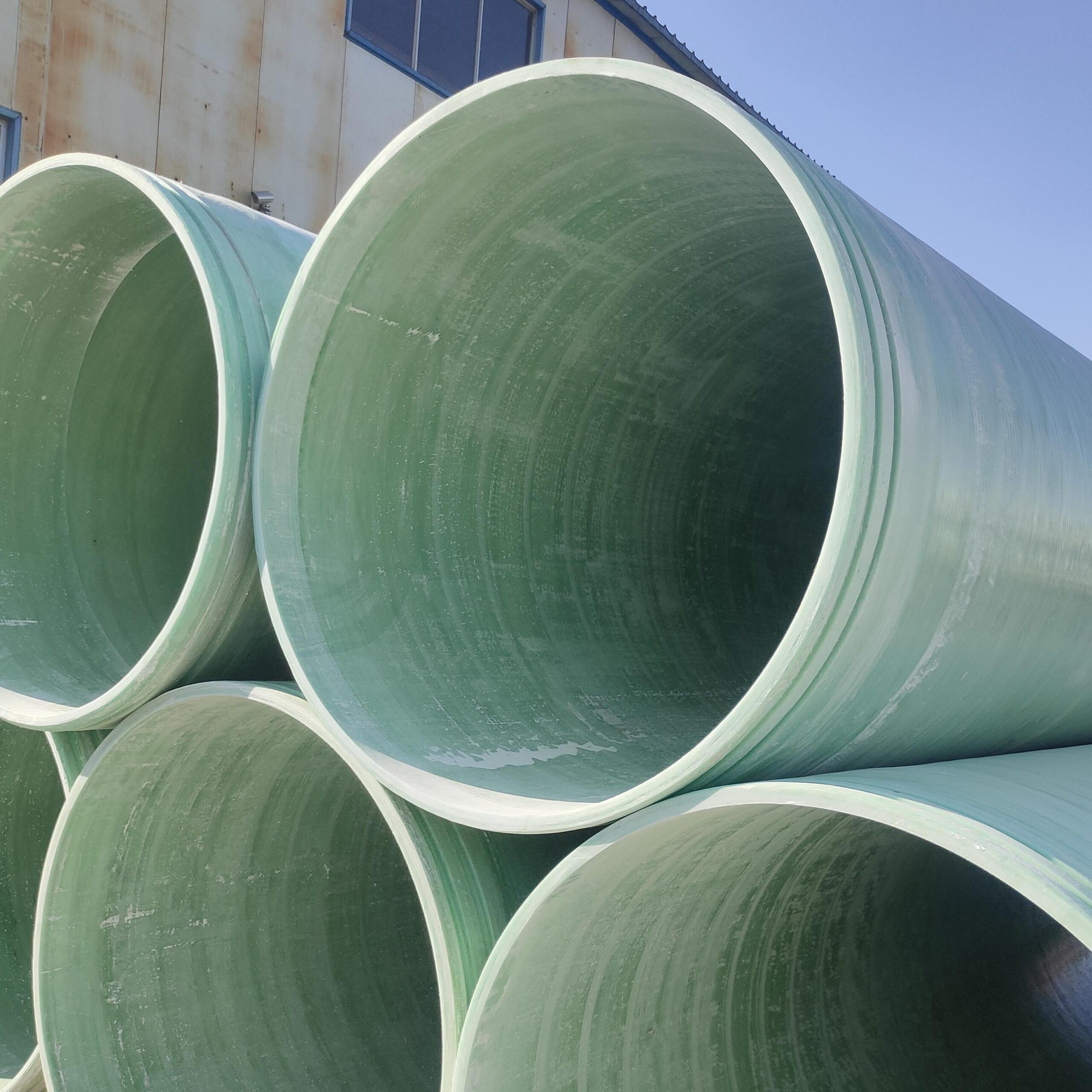
FRP sand pipe — also called glass fibre reinforced plastic sand pipe or FRP composite sand pipe — is a stiffened variant of conventional FRP pipe. A core of resin-bonded silica sand sits between the inner and outer glass-reinforced structural layers, raising ring stiffness and reducing cost without a proportional loss of strength. It is widely used for buried water, sewage and irrigation mains where stiffness against soil load governs the design more than internal pressure does.
How It Differs From Standard FRP Pipe
Standard FRP pipe derives stiffness from glass content and wall thickness. Sand pipe substitutes a cheaper, stiffer filler for some of that structure:
- Inner liner — resin-rich corrosion and abrasion barrier with a surface veil
- Inner structural layer — glass-reinforced laminate carrying hoop stress
- Sand core — resin-bonded silica sand, providing the bulk of the ring stiffness
- Outer structural layer — glass-reinforced laminate
- Outer protective layer — UV and weather protection
The practical result is a pipe with high stiffness-to-cost ratio. It is heavier than plain FRP pipe — that is the trade-off — but still far lighter than concrete or ductile iron.
Where Sand Pipe Is the Right Choice
- Buried gravity and low-pressure mains where external soil load dominates
- Municipal water and sewerage networks
- Irrigation and drainage schemes
- Cooling water and circulating water lines in power and industrial plants
- Desalination and seawater intake where large diameters make stiffness the governing criterion
Where internal pressure is high, standard filament-wound FRP pipe or a higher glass content is usually the better answer. Sand pipe is a stiffness solution, not a pressure solution.
Specification Essentials
When enquiring about FRP composite sand pipe, state:
- Nominal diameter and length
- Pressure class and surge allowance
- Stiffness class (ring stiffness, typically per ASTM D2412 or the applicable national standard)
- Burial depth, soil type and whether traffic loading applies
- Medium — potable water, sewage, seawater, or a specific chemical
- Temperature range
- Jointing system preference
- Applicable standard — for example a national water authority specification, AWWA C950, or BS EN 1796
Advantages
- High stiffness at moderate cost — the core reason for choosing it
- Corrosion resistance — no rust, no cathodic protection, no internal lining
- Hydraulic efficiency — smooth bore, and it stays smooth; the Hazen-Williams coefficient does not degrade with age as it does in metallic pipes
- Light weight versus concrete or ductile iron, cutting transport and installation cost
- Long service life in buried water and sewage duty
Installation Notes
Sand pipe installation follows buried flexible-pipe practice:
- Trench to the specified width with working clearance
- Bed on compacted fine material, free of sharp stones
- Compact haunch material carefully — voids here cause deflection
- Backfill in layers to the specified density
- Follow the manufacturer‘s jointing procedure exactly; joint integrity governs long-term performance
- Verify deflection after backfilling where the specification requires it
Quality Verification
Ask your FRP sand pipe manufacturer for: ring stiffness test results, initial ring deflection data, pressure test certificates, resin and glass traceability, dimensional reports, and joint qualification testing. For potable water, request the drinking-water certificate covering the inner liner resin.
Planning a buried pipeline? Send us the diameter, pressure and stiffness class, soil conditions and medium — we will specify the wall build-up and jointing, and provide a delivered quotation with test documentation.