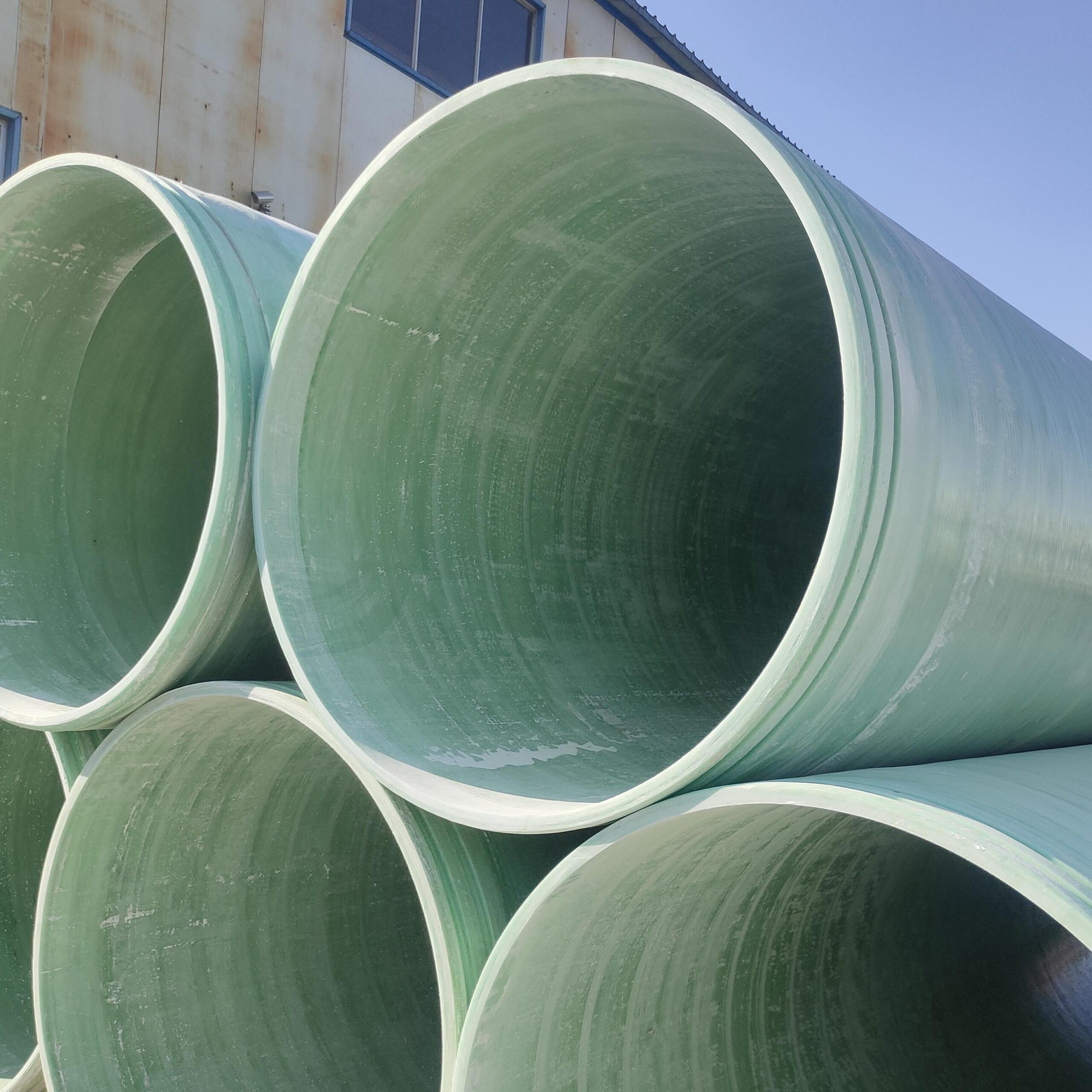
FRP pipe (also written GFRP or GRP pipe) carries water, chemicals, seawater and effluent in applications where steel would corrode and where concrete or ductile iron is too heavy or too costly to install. Understanding how FRP pipe is made — and how the resin and wall construction determine its duty — is the basis for specifying it correctly.
How FRP Pipe Is Made
Filament winding
Continuous glass roving, wetted with resin, is wound onto a rotating mandrel at programmed angles. The helical layers carry hoop stress; additional layers at low angles carry axial load. This route produces high-strength, consistent pipe and is standard for pressure duty.
Centrifugal casting
Resin, glass and filler are metered into a rotating mould; centrifugal force compacts the wall against the mould surface. Produces a dense, smooth pipe with excellent dimensional consistency, commonly used for water and sewer mains.
Wall Construction
A typical FRP pipe wall is built in functional layers:
- Inner liner — resin-rich layer with a surface veil, providing chemical resistance and a smooth hydraulic surface
- Structural laminate — glass-reinforced layers carrying pressure and external load
- Outer layer — UV and weather protection for exposed installations
Some designs add a sand or mineral filler core between structural layers to increase stiffness and reduce cost — the basis of FRP sand pipe, covered separately.
Resin Selection
Resin determines chemical and temperature capability:
- Orthophthalic polyester — water and mild effluent; the economical baseline
- Isophthalic polyester — potable water, seawater, broader chemical range, higher temperature
- Vinyl ester — aggressive chemicals, high temperature, and chemical resistant FRP pipe duty
- Epoxy — used where higher mechanical performance or specific chemical resistance is needed
For acid service, a fiberglass acid resistant pipe built on vinyl ester with a synthetic veil is the conventional specification. Confirm compatibility against the specific acid, concentration and temperature — “acid resistant” alone is not a specification.
Strength and Pressure Rating
High strength FRP pipe and high pressure GFRP pipe achieve their ratings through fibre orientation and glass content. What to state in an enquiry:
- Design pressure, including surge / water hammer allowance
- External load: burial depth, soil type, traffic
- Stiffness class required (ring stiffness, typically to ASTM D2412)
- Temperature range
- Medium and concentration
- Required design standard (ASTM D2996, AWWA C950, BS EN 1796 or equivalent)
Applications
- Potable water transmission and distribution
- Seawater intake, cooling water and desalination plants — a major application for desalination FRP pipe
- Chemical process lines and FRP chemical pipe
- Sewage, effluent and erosion resistant FRP pipe for slurry
- Irrigation and agricultural water
- Power plant circulating water and flue gas desulphurisation lines
- Fire mains where corrosion resistance is valued
Installation Notes
FRP pipe is light, which speeds installation, but it is less tolerant of abuse than steel:
- Support on broad saddles or continuous bedding; avoid point loads
- Use the manufacturer’s jointing system — bell-and-spigot with elastomeric seals, or butt-and-wrap laminated joints
- Allow for thermal expansion; FRP expands more than steel
- Backfill buried lines with selected fine material, compacted in layers
- Protect from impact damage during handling and backfilling
- Do not hang heavy valves or equipment off the pipe without independent support
Selecting a Manufacturer
Look for evidence of: in-house winding or casting, pressure and stiffness test reports, resin traceability, compatibility statements for the actual medium, joint system qualification, and installation support. A manufacturer with a genuine lightweight FRP pipe capability will also be able to demonstrate weight savings against the ductile iron or steel alternative for your pressure class.
Specifying FRP pipework? Send us the medium, pressure, temperature, diameter and installation conditions — we will recommend a resin, wall construction and jointing system, and return a full specification.