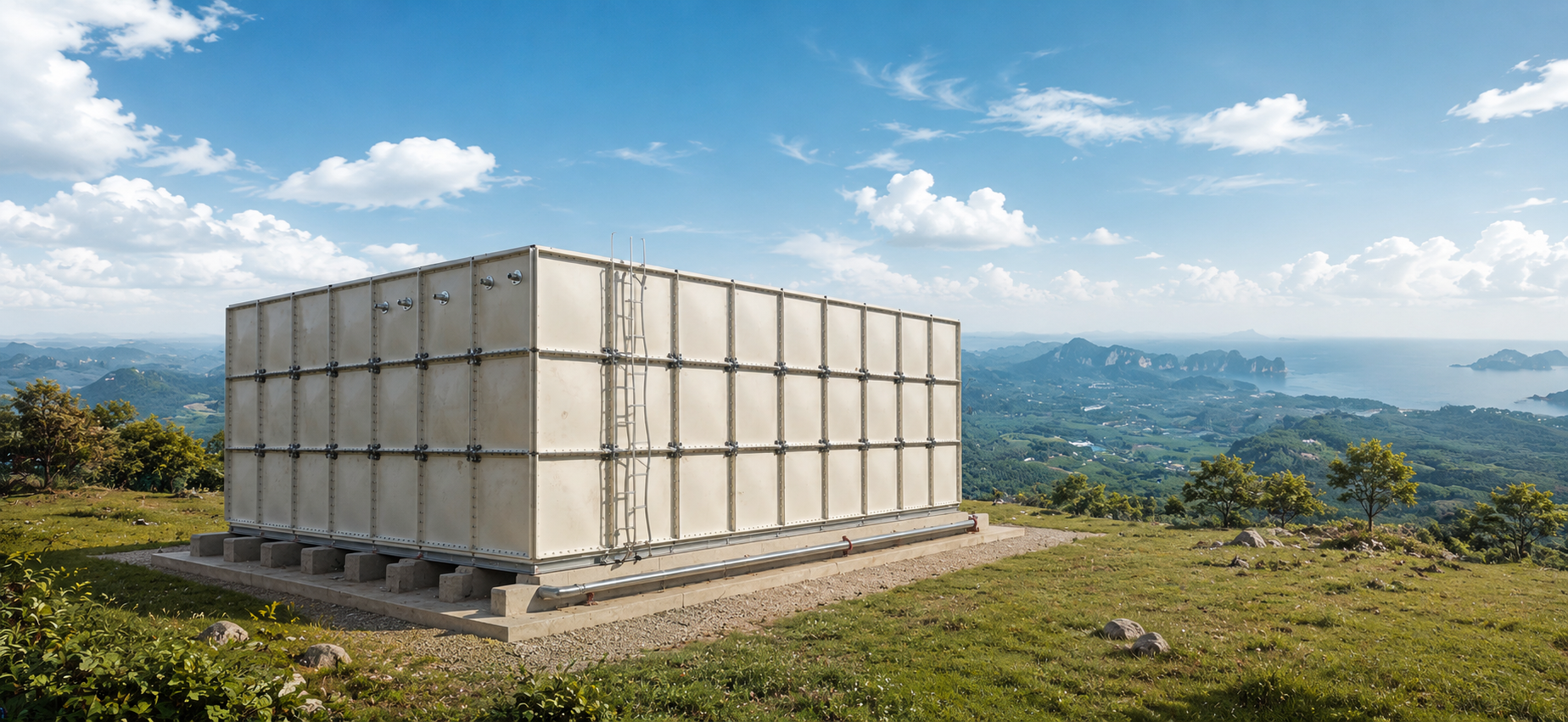
An industrial water tank is specified against a process rather than a convenience: a defined volume, at a defined quality, available at a defined rate, sometimes at a defined temperature, day after day. That makes the specification more demanding than a domestic tank, and the consequences of getting it wrong more expensive. This guide covers the main industrial configurations and the requirements that distinguish them.
What Makes Industrial Storage Different
- Defined quality — process water, demineralised water, or water meeting a product-contact standard
- Continuous duty — designed for a throughput, not just a static volume
- Integration — level control, telemetry, pumps, heating or cooling, and sometimes agitation
- Chemical exposure — process chemicals, effluent, or aggressive raw water
- Compliance — environmental permits, bunding, and discharge consent
- Downtime cost — a failure stops production, so access for inspection and repair matters
Common Industrial Configurations
- Raw water storage — intake water held before treatment; large volume, moderate quality requirement
- Process water tank — treated water at a defined quality, feeding production
- Demineralised / RO permeate storage — needs a tank that will not leach; stainless or a high-specification FRP liner
- Cooling tower make-up and chilled water buffer — volume matched to the system’s surge and retention needs
- Effluent and wastewater holding — often with chemical resistance and odour control requirements
- Fire reserve — governed by fire code rather than process need
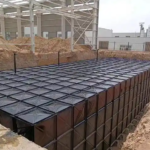
- Surface water infiltration and attenuation — buried modular systems that detain and release stormwater at a controlled rate; design is driven by the hydrograph and the discharge consent, not simply by volume
Material Selection
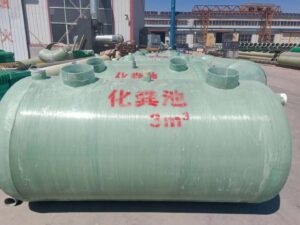
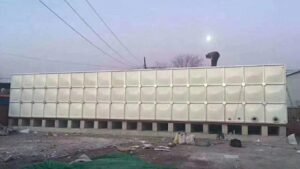
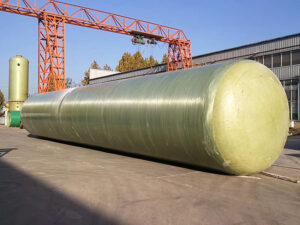
- FRP / GRP — the industrial default where corrosion resistance and chemical compatibility matter. Resin selected against the medium: iso for water, vinyl ester for aggressive chemicals.
- Stainless steel — 304 or 316L for hygienic, pharmaceutical and high-purity duty.
- Concrete — for very large volumes; requires a lining and is slow to construct.
- Coated carbon steel — still used for large fire reserves and some process duties; needs coating management.
For specialised duties, variants such as an FRP backwater tank, an OEM CPVC-lined FRP tank or an OEM PVC-lined FRP tank exist where a thermoplastic liner is bonded inside a structural FRP shell — combining chemical resistance with structural strength.
Design Requirements to Specify
- Contents — named, with concentration, temperature and pH
- Volume, plus the working range between high and low level
- Throughput — fill and draw rates, which drive nozzle and vent sizing
- Temperature control — insulation, heating or cooling
- Agitation or mixing if required
- Instrumentation — level transmitter, low/high alarms, sometimes temperature and flow
- Access — manway, internal ladder, external platform
- Containment — bunding where the environmental permit requires it
- Design standard and any certification
- Maintenance access and isolation arrangements
Nozzle and Vent Sizing
Industrial tanks fail at the details more often than in the shell. Size the vent for the maximum of the fill and drain rates — an undersized vent is the classic cause of vacuum collapse during draining. Support all pipework independently; pipe load on a nozzle cracks the laminate. Provide isolation valves so the tank can be taken out of service for cleaning without shutting the plant.
Inspection and Maintenance
Set a schedule against the duty: external inspection monthly or quarterly, internal annually, with photographic records. For contained or hazardous liquids, keep the bund clear and functional, and maintain the inspection log that the environmental permit requires. Confined-space procedure applies for every internal entry.
Specifying an industrial tank? Send us the medium, concentration, temperature, volume and throughput — we will recommend a material and resin system, size the connections and vents, and provide a full specification with drawings.