Every modular SMC tank starts as a flat panel. Understanding how SMC water tank plates are made is the fastest way to separate a manufacturer that controls its own moulding from a reseller buying commodity panels — and that difference shows up directly in tank life, water quality and warranty claims.
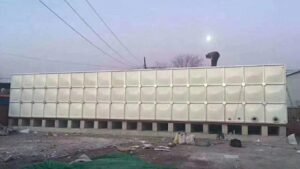
This article walks through the SMC material system, the compression moulding cycle, quality control checkpoints, and what to ask a supplier before you commit to a specification.
Sheet Moulding Compound is a ready-to-mould reinforced thermoset sheet. A standard water-tank formulation is built from:
The compound is doctored onto carrier film, sandwiched, and matured for 24–72 hours until it reaches a leathery, handleable consistency. Maturation is not a formality — moulding SMC too early or too late is a leading cause of surface defects and variable mechanical properties.
Sheet is cut to a charge pattern and weighed. Charge weight and placement determine how the material flows to fill ribs, bosses and flanges.
Charge is placed in the heated matched-metal tool. Tool temperature is typically 140–160 °C, held within a tight band across the platen.
The press closes at controlled speed; material flows and fills the cavity. Cure pressure is generally 5–15 MPa and cycle time runs 2–6 minutes depending on thickness. In-mould coating may be applied for enhanced UV or hygiene performance.
The panel is removed, flash is trimmed, and holes are drilled or moulded. Because both faces form against polished tooling, SMC panels need no gelcoat and no post-grinding.
A credible SMC water tank plate manufacturing operation will hold records on:
Many tank brands assemble tanks from panels bought on the open market. The tell-tale signs are inconsistent panel colour between batches, flanges that vary in thickness, and an inability to produce certified test data tied to a specific batch.
An integrated SMC water tank manufacturing company controls resin formulation, glass loading, tool maintenance and cure parameters — which means panel dimensions are repeatable, spare panels ordered five years later will fit, and hydrostatic test evidence is traceable.
Common modular panel formats are 1 m × 1 m, 1 m × 0.5 m, 1 m × 2 m and 1.5 m × 1 m. Thickness is graded by panel position and design water depth — bottom panels and lower courses are thicker because they carry the highest hydrostatic load. A manufacturer should supply a panel schedule showing thickness by course for your specific tank height.
The same presses and material system produce a wide range of compression-moulded parts. Manufacturers with SMC capability routinely supply septic tank shells, water tanker bodies and covers, and automotive components such as SMC car fuel tank covers, where the material’s combination of dimensional stability, corrosion resistance and Class-A surface finish is the deciding factor.
Getting written answers to those six questions before awarding a contract prevents most of the disputes that arise in sectional tank projects.
Specifying a tank? Send us (armand@smcwatertank.com) your tank dimensions and water duty and we will return a stamped panel schedule with thickness by course, material certificates and a hydrostatic test report.
 +86 15806657767
 lucy@smcwatertank.com
 86 150 6612 7396

86 150 6612 7396
 your.page.name
 SMC GRP Water Tank
 Phone
+86 15806657767
Email
lucy@smcwatertank.com
WhatsApp
86 150 6612 7396
Facebook
your.page.name
WeChat
SMC GRP Water Tank