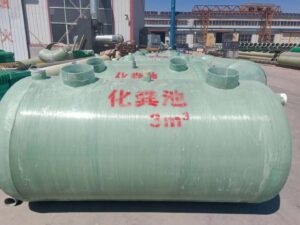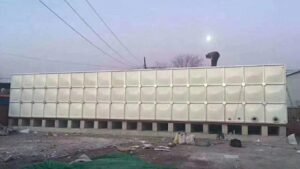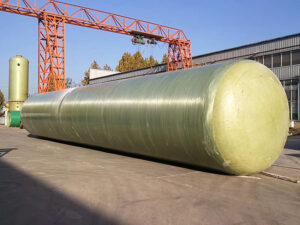
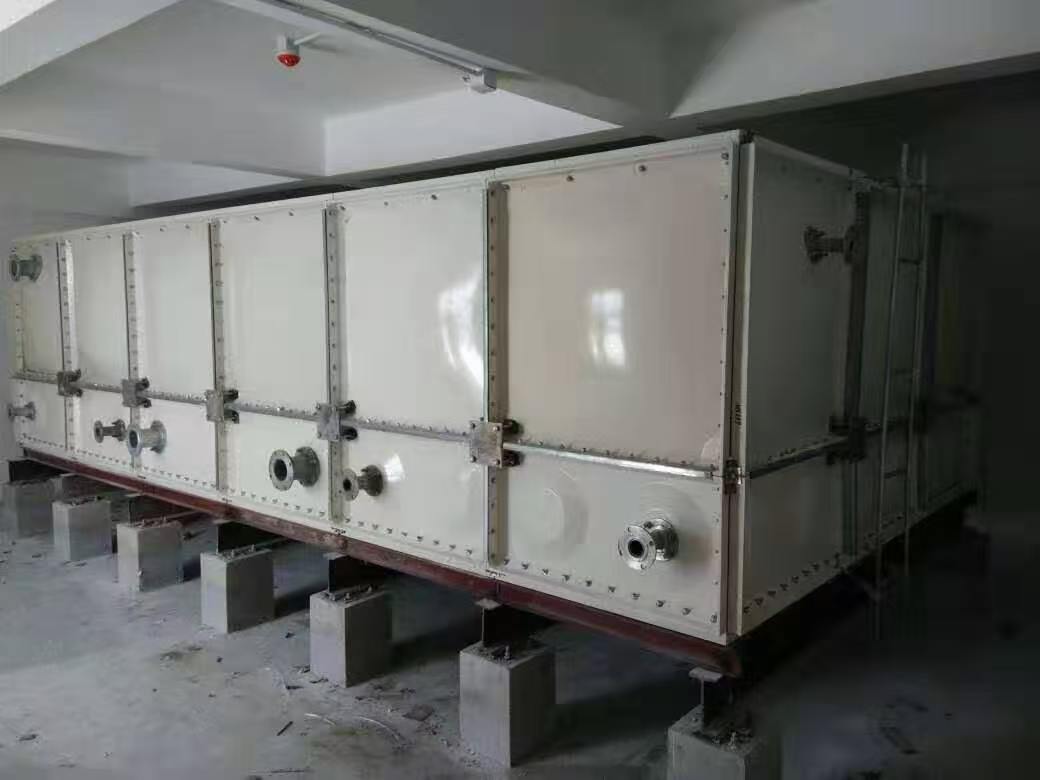
A horizontal FRP tank is chosen when height is the constraint: plant rooms with low headroom, transportable skids, mobile units, and sites where a vertical tank would need a crane lift that the space cannot accommodate. The configuration is straightforward but has one critical requirement — correct saddle support — that is frequently got wrong.
When to Choose Horizontal
- Limited headroom or a low door/ceiling
- Transportable or skid-mounted installations — including tanker bodies and mobile water supply units
- Road-transportable units within legal width and height limits
- Rooftop or plant-deck locations where a tall tank would be conspicuous or wind-loaded
- Process layouts where gravity feed to equipment below is needed
Where footprint is plentiful and headroom is not a problem, a vertical tank is usually more economical for the same volume and drains more completely.
Saddle Support: The Critical Detail
A horizontal cylindrical shell carries load very differently from a vertical one. The tank must sit on saddles that distribute the load around a broad arc:
- Contact angle — typically 120–150°. A narrow saddle concentrates load and deforms the shell.
- Saddle count and position — normally two, positioned so the overhang is limited; the manufacturer’s drawing governs.
- Wear pad — a resilient layer between shell and saddle to prevent abrasion and point loading.
- One fixed, one sliding — to accommodate thermal expansion without inducing stress.
- Level foundation — both saddles must be level and at the same elevation; a twisted installation distorts the shell.
Shell deformation from poor saddling is the most common cause of premature failure in horizontal installations. It is also entirely avoidable.
Construction
Horizontal tanks are most often filament-wound, with winding angles set to carry both hoop stress and the bending loads introduced by saddle support. Wall build-up follows the standard pattern:
- Internal corrosion liner, resin-rich with a surface veil
- Structural laminate, glass-reinforced
- External UV and weather protection
Where stiffness governs — large diameters, thin walls — a sandwich or ribbed construction may be specified. A horizontal FRP composite tank of this type can achieve long spans between saddles without excessive wall thickness.
Applications
- Potable water storage in low-headroom plant rooms
- Transportable water and chemical tanks on skids or trailers
- Fuel and oil storage (with a compatible resin and, usually, secondary containment)
- Process vessels, surge tanks and buffer tanks
- Septic and effluent holding tanks
- Rainwater harvesting tanks under driveways or in crawl spaces
Specifying a Horizontal Tank
- Volume and maximum available length, width and height
- Contents, concentration and temperature
- Pressure and vacuum conditions — including during draining
- Saddle arrangement, or ask the manufacturer to design it
- Nozzle schedule — inlet, outlet, drain, vent, manway, level
- Whether it will be static or transported — transport adds dynamic load and baffle requirements
- Lifting and tie-down points for skid mounting
- Applicable standard and any certification
Installation Notes
- Prepare a level foundation or a fabricated skid; check level in both axes
- Set the tank on saddles with the wear pad in place; never on the shell directly
- Leave one saddle free to slide if specified
- Support pipework independently — no load on nozzles
- Anchor against flotation or movement where required, using the designated points
- Fill and test; re-check saddle contact after the first fill
Need a low-profile tank? Send us the volume, available height and contents — we will design the shell, specify the saddles and provide a full installation drawing.