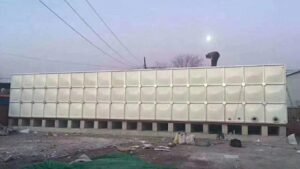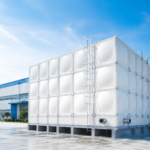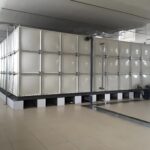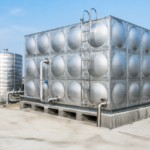
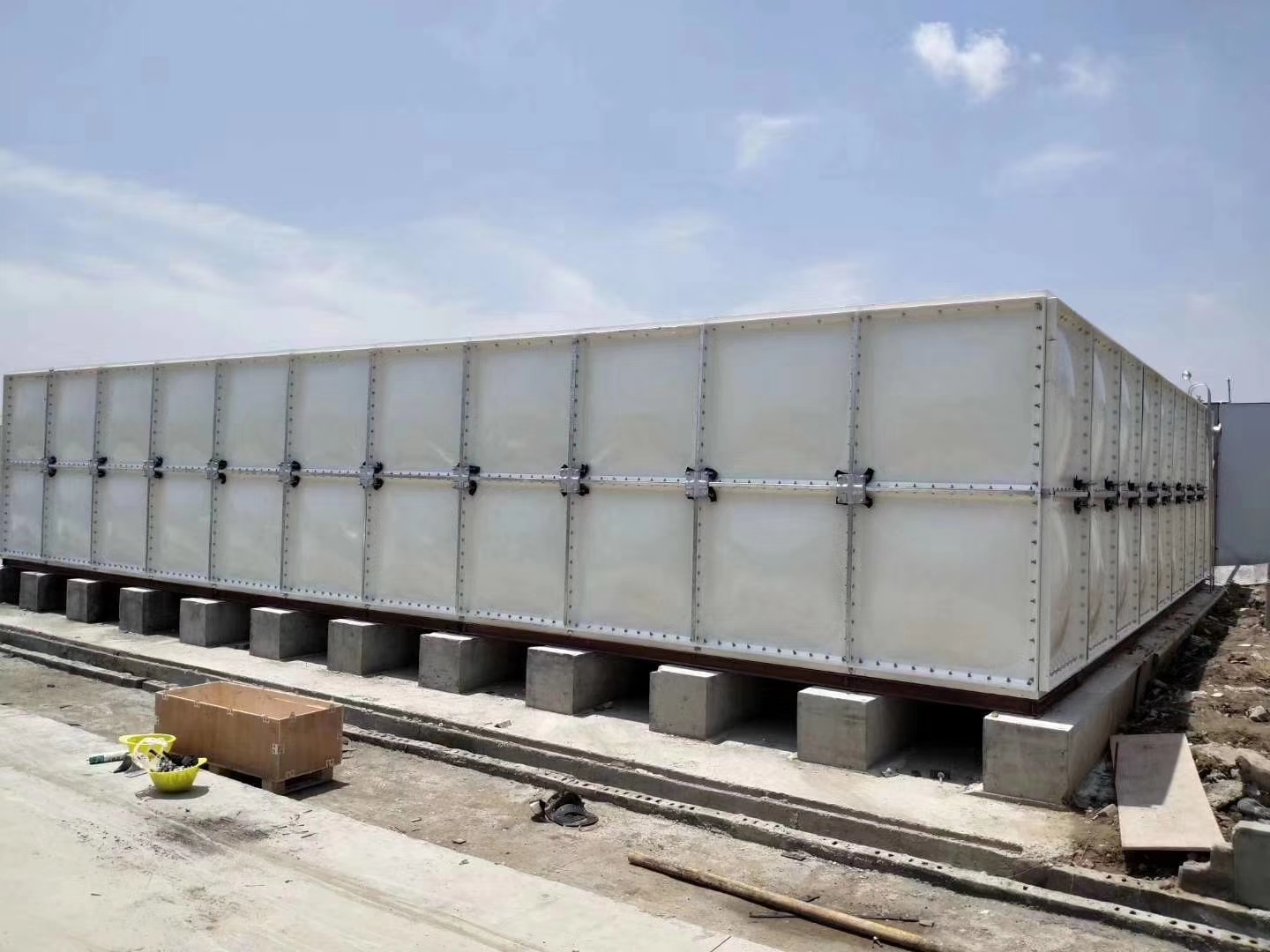
An SMC water tank is a modular liquid storage system built from Sheet Moulding Compound (SMC) panels that are bolted together on site. Unlike monolithic tanks, an SMC panel tank arrives as flat compression-moulded plates, which means a 200 m³ tank can be carried through a standard doorway and assembled inside a basement plant room. This modularity is the single biggest reason SMC tanks have displaced concrete and welded steel in commercial buildings across Asia, the Middle East and Africa.
This guide covers what SMC actually is, how SMC panel tanks compare with GRP and FRP alternatives, the standards that apply to potable water tank, sizing logic, and what to check before you buy.
What Is SMC (Sheet Moulding Compound)?
SMC is a reinforced thermoset composite. A typical formulation combines unsaturated polyester resin, chopped glass fibre roving (usually 25–30% by weight), mineral filler such as calcium carbonate, and a suite of additives: low-profile agents for surface finish, thickeners (MgO or Mg(OH)&sub2;) to raise viscosity, internal release agent, and pigment.
The material is supplied as a leather-like sheet, cut to charge, and placed in a matched metal tool. Under heat (140–160 °C) and pressure (typically 5–15 MPa) it flows and cures into a rigid, dimensionally stable panel. Because both faces are formed against polished steel tooling, SMC panels come out with a smooth, gelcoat-free finish on both sides — which matters for hygiene and for cleaning.
SMC vs GRP vs FRP: Clearing Up the Terminology
The terms are often used interchangeably in the water tank industry, and that causes confusion in specifications. Here is the practical distinction:
- SMC — compression-moulded flat panels, bolted together. Always modular, always panel-based.
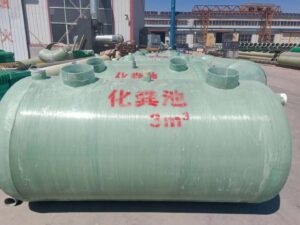
- GRP (Glass Reinforced Plastic) — the UK/European term for the same glass-polyester family. A GRP sectional tank is functionally the panel-tank concept under a different regional name.
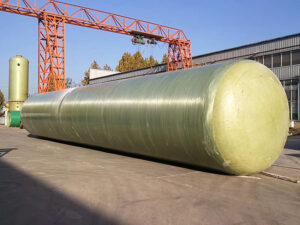
- FRP (Fibre Reinforced Plastic) — the US/Asian umbrella term. In practice an FRP water tank may be a panel tank, a one-piece moulded tank, or a filament-wound vessel.
So SMC panel water tanks, GRP sectional water tanks and FRP panel tanks all describe substantially the same product family. The differences that actually affect performance are resin grade, glass content, panel thickness and the quality of the hot-press tooling — not the acronym.
How an SMC Panel Water Tank Is Built
Panel moulding
Standard panel sizes are 1 m × 1 m, 1 m × 0.5 m, 1 m × 2 m and 1.5 m × 1 m, with thickness graded by duty. Ribs are moulded into the outer face to carry hydrostatic load, which is why a relatively thin panel can hold several metres of water head.
Sealing and bolting
Panels are joined with food-grade gasket tape (EPDM or PVC) bedded into the flange channel, then bolted through the perimeter flange with stainless steel or hot-dip galvanised fasteners. Internal tie rods and stays transfer the water load from the walls to the panel joints. A correctly assembled sectional tank is watertight at the first fill — no curing or welding is required on site.
Foundation
The tank needs a level, load-bearing base. For indoor plant rooms a reinforced concrete slab is normal; outdoors, a concrete raft or a galvanised steel skid (channel base) is used. Uneven support is the most common cause of long-term joint leakage, so base flatness is worth insisting on.
Key Benefits of SMC Water Tanks
- Hygienic — smooth, non-porous surfaces resist biofilm; potable grades are certified to NSF/ANSI 61 or equivalent.
- Corrosion-proof — no rust, no need for internal coating, unlike carbon steel.
- Lightweight — roughly one-third the weight of an equivalent concrete tank, cutting foundation and crane costs.
- Modular — capacity can be extended by adding panel courses, and the tank can be dismantled and relocated.
- Thermally stable — optional PU or rockwool insulation cores hold water temperature and reduce condensation.
- Long service life — 25–30 years is routine for a well-maintained installation.
Typical Applications
- Domestic potable water storage for apartments, hotels and hospitals
- Fire reserve (sprinkler and hydrant) tanks — often the largest single application by volume
- Raw water and process water in factories
- Rainwater harvesting and irrigation
- Cooling tower make-up and chilled water buffer
Standards and Potable Water Compliance
For drinking water, the resin and panel system must be certified for contact with potable water. Buyers commonly specify:
- NSF/ANSI 61 — drinking water system components (health effects), the North American benchmark.
- BS EN 13280 — European specification for GRP tanks for water supply.
- WRAS approval — required for connection to UK mains.
- Local potable certification — many Middle East and ASEAN projects require a ministry or municipal certificate in addition to the above.
Ask your supplier for the certificate that covers the actual panel formulation, not a generic company certificate. This is the single most common gap in tender submissions.
Choosing Capacity and Configuration
Sizing is driven by two independent demands that are often stored in the same tank with a divider: domestic consumption (typically 1–2 days of occupancy demand) and fire reserve (a fixed volume set by the applicable fire code, usually 1–2 hours of sprinkler demand plus hydrant allowance). Because fire reserve must never be drawn down for domestic use, specify a divided tank with an independent fire suction line, or two separate tanks.
SMC Water Tank Installation — What to Verify
Installation is fast compared with welded alternatives, but three items determine whether the tank stays watertight:
- Level base — verify with a spirit level or laser before the first panel goes down; shim as needed.
- Gasket continuity — joints must be continuous with no gaps at panel corners; use the manufacturer’s specified tape, not a generic substitute.
- Bolt torque — tighten progressively in a cross pattern; over-torquing cracks flanges, under-torquing leaks.
Maintenance
SMC tanks are low-maintenance but not zero-maintenance. Plan an annual internal inspection, clean and disinfect at commissioning and after any contamination event, and re-torque bolts after the first fill and again at 12 months. External insulation and the overflow screen should be checked at the same visit.
Frequently Asked Questions
How long does an SMC water tank last?
25–30 years in potable service is typical. Panels themselves rarely fail; gaskets and bolts are the wear items and are replaceable in the field.
Can an SMC tank be installed underground?
Panel tanks are designed for above-ground or basement installation. For buried duty, specify a dedicated underground FRP tank engineered for soil and traffic loads with appropriate ring stiffness.
Can capacity be increased later?
Yes, within limits. Adding courses increases height and load on lower panels, so the original structure must have been designed with the extra head in mind. Confirm with the manufacturer before planning an extension.
Need a quotation or a sizing calculation? Send us your required volume, footprint and water quality (potable / fire / process) and we will return a panel schedule, foundation drawing and budget price.